

This page has been restored from the legacy English corpus and selected for indexing after conservative technical review.
Graphitized petroleum coke recarburizer features high fixed carbon, low sulfur, and high absorption rate. It effectively increases carbon content and improves product quality, widely used in steelmaking, casting, and carbon industries.
【Graphitization】What Is the Process?
Graphitization Process
The graphitization process is a heat-treatment process. During graphitization, there are both endothermic and exothermic processes at different temperature stages, which can be divided into the following three stages:
Stage One
Stage One (1000–1800 ℃):
At temperatures higher than those used for baking, the products further release volatile matter. All remaining aliphatic chains, C-H bonds, C=O bonds, etc., successively break within this temperature range. Carbon atoms, hydrogen, oxygen, nitrogen, sulfur, and other monomers or simple molecules (CH, CO, CO2, etc.) between the turbostratic structure layers are also discharged at this stage. Some disordered and dispersed planar molecules combine into larger molecules.
In this temperature range, the endothermic process is mainly the continuation of chemical reactions. At the same time, physical processes also occur, manifested by the disappearance of some microcrystal boundaries. The original interfacial energy is released in the form of heat, serving as the driving force promoting the ordering of carbon hexagonal networks.
According to X-ray analysis, within this temperature range, there is no obvious increase in the stacking of carbon atomic layers. Their ordered arrangement occurs within a two-dimensional plane, with the two-dimensional plane size not exceeding 8 nm, and the large molecules still maintain a turbostratic structure.
Stage Two
Stage Two (1800–2400 K):
At this stage, there are two situations. First, as the temperature rises, the system obtains more energy. The thermal vibration frequency of carbon atoms increases, and the vibration amplitude becomes larger. Governed by the law of minimum free energy, the network layers transition toward a three-dimensional graphite structure, and the interlayer spacing decreases.
Meanwhile, the vibration amplitude of carbon atoms parallel to the planar network direction increases, and dislocation lines and grain boundaries on the crystal planes gradually disappear, releasing latent heat. By 2000 K, the entropy increment of the system reaches its minimum point and continues above 2000 K, as shown in the entropy difference curve in Figure (13-6).
In the X-ray diffraction spectrum of graphite treated at this temperature, relatively sharp (hko), (001), and some (hkl) lines gradually appear, proving that a three-dimensional ordered arrangement has occurred. This is an annealing process that releases internal energy.
Another parallel reaction occurring at 2000–2400 K is that some impurities form carbides (mainly silicon carbide), which subsequently decompose into metal vapor and graphite at higher temperatures.
In addition, near 2400 K, carbon begins to evaporate and thermal defects appear, all of which consume energy. Since these processes occur more actively between 2000–2400 K, the system absorbs thermal energy, resulting in a renewed increase in entropy change.
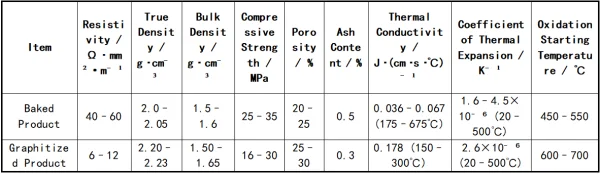
Table 13-6 Comparison of Physical and Chemical Properties Between Baked Products and Graphitized Products
Stage Three
Stage Three (Above 2400 K):
For graphitizable carbons such as petroleum coke and pitch coke, at 2400 K the average crystal growth along the a-axis direction reaches 10–150 nm, while the c-axis direction reaches about 60 layers (approximately 20 nm).
Due to the ordering process in the previous stage, crystal shrinkage occurs, and the gaps between crystal interfaces expand. According to the crystal growth mechanism discussed above, even if the temperature continues to rise, the crystals still cannot move closer together or bond into larger crystals. At this stage, crystal growth relies on a new mechanism, namely the recrystallization process.
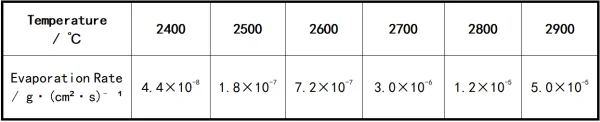
This recrystallization process involves, on one hand, the movement of carbon atoms within or between planar carbon molecules, completing lattice perfection and three-dimensional arrangement. On the other hand, at temperatures above 2400 K, the evaporation rate of carbon substances increases exponentially with temperature (see Table 13-4).
Table 13-4 Changes in the Evaporation Rate of Carbon Substances with Temperature
At this point, the graphitization system is filled with carbon atoms and molecular gases such as C, C2, C3 (C2+C), C4 (C3+C), etc., where extremely active material exchange and recrystallization occur between the solid phase and gas phase.
In summary, the various stages of the graphitization process of carbon overlap with each other. At temperatures slightly higher than calcination and baking, decomposition-polymerization reactions occur. Between 1700–2400 K, annealing, microcrystal growth, and the formation and decomposition of carbides mainly take place, promoting graphitization. Above 2400 K, recrystallization characterized by carbon atom migration becomes dominant.
Throughout the entire graphitization process, graphitizable carbon undergoes both homogeneous and heterogeneous graphitization. Although endothermic processes occur, the more essential process is exothermic. The entropy change of the system increases, making it more stable.
Non-graphitizable carbon materials can also undergo heterogeneous crystallization at high temperatures, but they require temperatures higher than those for graphitizable carbon. At temperatures above 3200 K, cross-linking bonds begin to break. According to molecular orientation, numerous crystallization centers are formed, and sublimated carbon atoms rearrange rapidly around these crystallization centers, forming fine crystalline graphite.
Feel free to contact us anytime for more information about the Graphite products market. Our team is dedicated to providing you with in-depth insights and customized assistance based on your needs. Whether you have questions about product specifications, market trends, or pricing, we are here to help.
Procurement Context
Use archive content as a starting point for specification review
For current orders, please confirm product name, target specifications, quantity, packing, destination and application. Final quotation depends on available batch and order confirmation.