

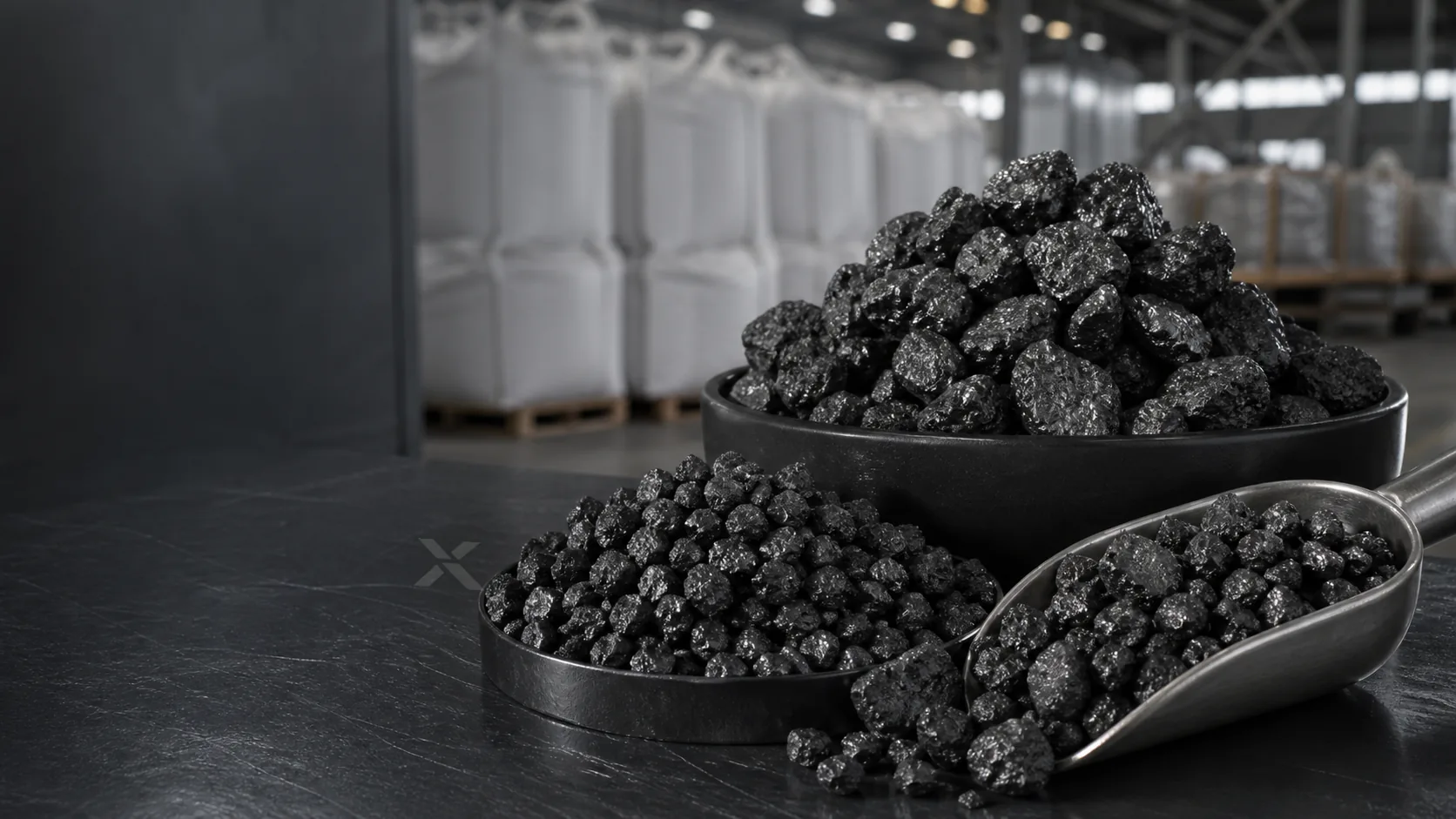
Recent price softening in standard 4.0% and 4.5% sulfur calcined petroleum coke (CPC) does not reflect margin concessions on pure domestic sponge coke, but rather a structural shift toward up to 100% imported green petroleum coke (GPC) blending.
Recent market quotes for standard high-sulfur calcined petroleum coke (CPC) have shown signs of softening, leading many downstream buyers to anticipate a broader downturn in carbon raw material costs. However, a quantitative cross-check against upstream green petroleum coke (GPC) prices and calcining yield fundamentals reveals that lower headline quotes are driven by feedstock substitution rather than standalone calciner discounting.
In the mainstream commercial high-sulfur CPC market, trading volume centers on two standard specifications: 4.5% sulfur GPC calcined down to 4.0% sulfur CPC, and 5.0% sulfur GPC calcined down to 4.5% sulfur CPC. On the upstream domestic market, high-sulfur green sponge coke quotes at independent refineries in Shandong currently stand between 2,300 and 3,070 RMB/ton, following a month-on-month average increase of approximately 4.2%. Even at the bottom of this range, domestic 4.5%–5.0% sulfur sponge coke commands 2,300 to 2,400 RMB/ton ex-works. Adding roughly 100 RMB/ton for short-haul freight puts the landed GPC cost at the calciner gate at 2,400 to 2,500 RMB/ton.
During high-temperature calcination, the expulsion of moisture and volatile matter results in an industry-standard mass conversion factor of approximately 1.28. Even under the most favorable operating assumption—where waste-heat recovery steam sales fully offset the ~200 RMB/ton calcining conversion fee—the hard feedstock cost floor for 100% domestic sponge coke remains rigid:
- For 4.5% sulfur CPC: (2,300 + 100) × 1.28 = 3,072 RMB/ton.
- For 4.0% sulfur CPC: (2,400 + 100) × 1.28 = 3,200 RMB/ton.
For calciners without external steam revenue, roughly 200 RMB/ton in conversion costs must be added on top. Yet open-market offers for commercial 4.0% and 4.5% sulfur CPC have frequently dipped below this 3,070–3,200 RMB/ton pure-feedstock threshold.
This inversion between finished CPC prices and domestic GPC costs highlights a structural change in kiln feed recipes. Because calcining 100% pure domestic sponge coke at current spot prices locks in immediate losses, independent calciners have widely shifted their feedstock mix toward imported green coke—including imported medium-to-high-sulfur sponge coke and high-sulfur Venezuelan grades—to flatten the 1.28 yield multiplier.
Where blending previously involved mixing 20% to 30% imported GPC into a domestic sponge coke base, blending ratios in the commercial spot market have climbed steadily, reaching up to 100% imported feedstock in many low-priced lots. While skilled blending allows producers to keep certificate-of-analysis sulfur levels precisely at 4.0% or 4.5%, CPC calcined from 100% imported alternative crudes exhibits distinctly different coking microstructures, trace metal profiles, and thermal behavior compared to pure domestic sponge coke.
For downstream carbon and metallurgical buyers, lower nominal CPC quotes should not be mistaken for a like-for-like price drop. Procurement evaluations must look beyond headline sulfur percentages to verify the underlying green coke origin and blending ratio.