




【Electric Furnace Steel】Policy Direction Set! The 2026 Steel Industry "Reduce Volume, ...

Graphite electrodes are the essential consumables in EAF steelmaking. Due to their outstanding electrical conductivity and excellent high-temperature resistance, they play a critical role in ensuring efficient and stable furnace operation, thereby improving steel production capacity and product quality.
【Electric Furnace Steel】Policy Direction Set! The 2026 Steel Industry "Reduce Volume, Improve Quality" Roadmap Has Been Clarified
On March 5, the Fourth Session of the 14th National People's Congress opened in Beijing, where Premier Li Qiang of the State Council delivered the Government Work Report. As the first year of the 15th Five-Year Plan, the policy direction for 2026 carries unusual significance for the steel industry, which is currently undergoing a deep adjustment period.
Macro expectations, rectification of "involution-style competition," green transformation, and new quality productive forces… behind these high-frequency keywords lie the next set of survival rules for the steel industry.
This article combines the original report and interpretations from authoritative institutions to outline the "construction blueprint" of China's steel industry in 2026.
I. Macro Direction: Finding Resilience Amid "Expectation Gaps"
The report sets a 2026 economic growth target of 4.5%–5%. Although slightly relaxed compared with the 5% target in 2025, the range remains pragmatic and retains a bottom-line mindset amid the backdrop of 21 provinces lowering their GDP targets.
Fiscal and monetary policies will continue to intensify, but for strongly cyclical bulk commodities, the key focus should be on the actual transformation behind incremental policies.
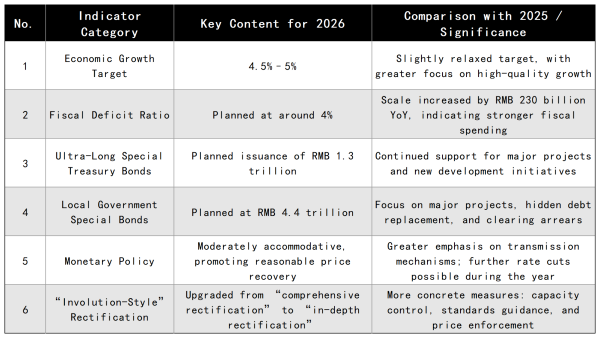
Data interpretation shows that although the magnitude of policy increments in 2026 is not large, the implementation path is clearer. The issuance of RMB 800 billion in new policy-oriented financial instruments (RMB 300 billion more than last year) is expected to drive RMB 9 trillion in total investment over the next three years, which will directly support infrastructure and manufacturing investment.
II. Demand Side: Saying Goodbye to "Mega Infrastructure" and Embracing "New Quality Productive Forces"
In the report, the target for energy consumption per unit of GDP has been adjusted to reducing carbon dioxide emissions per unit of GDP by around 3.8%. This shift marks more precise control of the green transition and also means that the structure of steel demand is undergoing a historic transformation—from "civil engineering steel" to "industrial steel."
Construction Steel: Supported but Not Driven Up
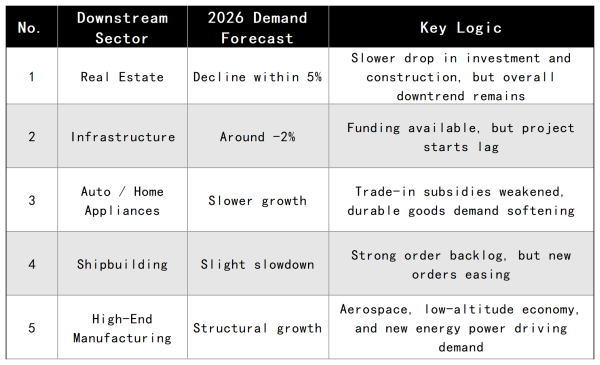
Real estate: Policy priorities focus on "controlling new supply, reducing inventory, optimizing supply," and building "better housing." Although the sales side may stabilize, investment and construction activities are expected to continue declining. It is estimated that steel demand from the real estate sector will decline slightly within 5% in 2026.
Infrastructure: Although support from budgeted investment and government bonds has slightly increased, project commencement may be delayed due to a decline in high-quality project reserves. It is estimated that steel demand from infrastructure will decline slightly by around 2% for the full year.
Industrial Steel: Structural Differentiation
Manufacturing industries such as automobiles, home appliances, and shipbuilding, although experiencing slower growth than in previous years, still act as stabilizers for steel demand.
III. Supply Side: Not Only "Controlling Output" but Also "Optimizing Structure"
In response to "involution-style" competition, the report clearly states that capacity regulation and other comprehensive measures will be used. This indicates that the supply-side logic in 2026 is not simply about reducing output but about survival of the fittest.
Production forecast: China's crude steel output is expected to decline by about 10 million tons in 2026. On the one hand, weaker demand suppresses the motivation for expansion; on the other hand, environmental regulations and capacity replacement policies limit production releases.
Product optimization: The share of construction materials (rebar and wire rod) will continue to decline, while the supply capacity of plate products (hot-rolled coil, cold-rolled coil, medium plate) and special steels (bearing steel, tool steel, etc.) will continue to increase to meet the upgrading demand of the manufacturing industry.
IV. Costs and Profitability: Will Profits Shift from "Mines" Back to "Steel Mills"?
In 2026, cost pressure in the steel industry is expected to ease marginally.
Iron ore: Overseas mine shipments are increasing, port inventories remain at historically high levels, and pig iron production is declining, widening the supply-demand imbalance. It is expected that the average iron ore price level will decline throughout the year.
Coking coal and coke: Supply-side contraction is significant, and prices are expected to remain resilient, but the likelihood of sharp increases is low.
Core judgment: As raw material costs decline, profits will be redistributed within the industrial chain, shifting slightly from the raw material segment to the smelting segment. However, due to generally weak finished steel demand and limited upward momentum for steel prices, industry profits are expected to improve only slightly from the current break-even level to a marginally profitable state.
V. "Survival Rules" for Steel Enterprises in 2026
In the first year of the 15th Five-Year Plan, relying solely on scale expansion is no longer a viable path. According to policy guidance, steel enterprises should focus on the following five differentiated strategies:
Technology leadership: Break through key technologies in high-end special steel and focus on materials for aerospace and high-end equipment.
Service extension: Upgrade from a pure materials supplier to a comprehensive solution provider, deeply integrating with downstream customers.
Green leadership: Turn low-carbon development into a compliance advantage. The report clearly states that the carbon market coverage will expand, and carbon asset management capabilities will become a new profit center.
Overseas layout: Obtain resource and market synergies through global deployment and avoid trade barriers.
Resource security: Strengthen domestic mine supply guarantees and price stabilization to enhance the security of the industrial chain.
VI. Market Observation: Execution and Implementation Are Key
The 2026 Government Work Report sets the tone for the steel industry as "reducing volume while improving quality."
For the industry, a 4% fiscal deficit ratio and RMB 1.3 trillion in special treasury bonds provide confidence as a bottom-line support, while the "in-depth rectification of involution-style competition" acts as a sword hanging over enterprises.
For practitioners, it is necessary to clearly recognize that the era of extensive growth driven by the real estate sector has completely ended.
The only viable path in the future is to closely follow the direction of "new quality productive forces" and "green and low-carbon development," finding one's own ecological position through high-end and intelligent transformation.
Large price fluctuations may become less common, but structural opportunities within narrow price ranges will be the real test of capability.
Source: Government Work Report, Mysteel, SteelHome, Lange Steel, Zhonggang Net, etc.
Feel free to contact us anytime for more information about the EAF Steel market. Our team is dedicated to providing you with in-depth insights and customized assistance based on your needs. Whether you have questions about product specifications, market trends, or pricing, we are here to help.
No related results found




0 Replies