

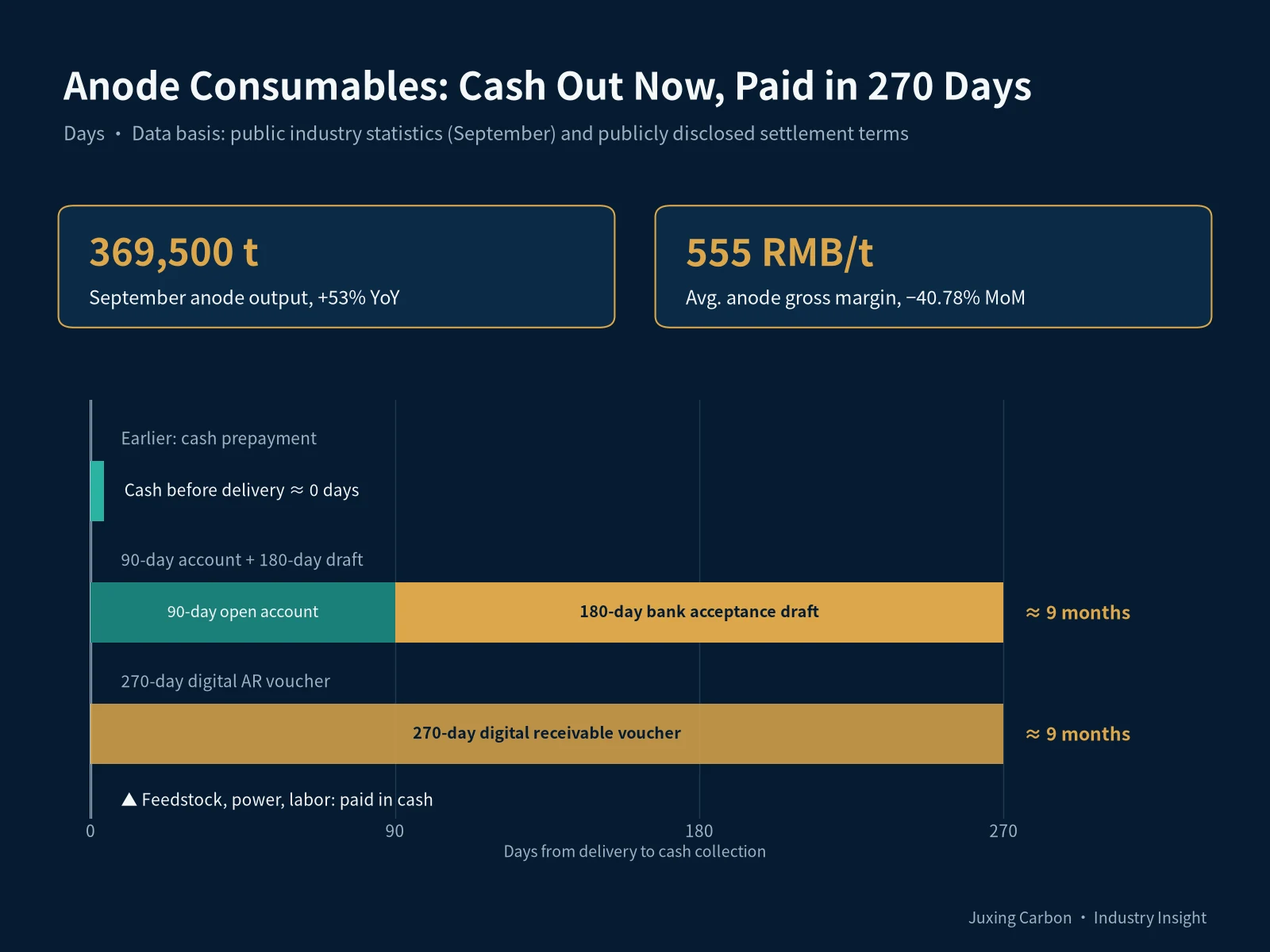
Despite a 53% year-on-year surge in lithium-ion anode output, carbon plants retooling for graphitization saggers and crucibles face severe cash-flow mismatches driven by 270-day settlement cycles and downstream gross margins compressed to just 555.01 RMB/ton.
China’s lithium-ion battery anode production recorded strong volume growth in September, with monthly output reaching 369,500 tons (up 53% year-on-year) and cumulative nine-month output totaling 2.7312 million tons. Encouraged by high downstream operating rates, a growing number of traditional carbon plants have begun modifying formulations and molds to convert their forming presses and baking furnaces toward graphitization consumables—specifically sagger plates and crucibles. Yet a closer examination of supply-chain settlement terms and downstream profitability points to acute working-capital risks behind this capacity shift.
Payment-Cycle Mismatch
Data basis: public industry statistics for September and publicly disclosed settlement terms.
The primary challenge lies in the severe mismatch between upstream cash outlays and downstream receivable cycles. Because saggers and crucibles are standardized industrial consumables with relatively low barriers to entry, rapid capacity conversion across the carbon sector has shifted bargaining power decisively to buyers. Whereas suppliers could demand cash prepayments two to three years ago, standard settlement terms disclosed in public filings now consist of a "90-day open account plus 180-day bank acceptance draft" or a 270-day digital accounts-receivable voucher—locking up capital for a full nine months. Meanwhile, carbon producers must pay cash upfront for green petroleum coke, modified coal tar pitch, electricity, and labor while financing weeks of in-plant kneading, molding, and baking.
| Settlement mode | Terms | Cash collected after delivery |
|---|---|---|
| Earliertight-supply phase | Cash prepayment before delivery | Cash first |
| Open account + draftcurrent mainstream terms | 90-day open account + 180-day bank acceptance draft | ~270 days90 + 180 |
| Digital AR vouchercurrent mainstream terms | 270-day digital accounts-receivable voucher | ~270 daysabout 9 months |
Note: feedstock, electricity and labor are paid in cash, and producers also finance weeks of kneading, molding and baking before delivery.
Downstream Margin Squeeze
Compounding the payment delay is the sharp compression in downstream anode profitability. A customer’s ability to pay promptly depends not on shipment tonnage, but on net cash generation. According to public industry data, average domestic lithium-ion anode prices stood at approximately 33,500 RMB/ton in September, with mainstream volume grades priced between 17,500 and 24,000 RMB/ton. At the same time, rising feedstock costs pushed average anode production cost to roughly 25,745 RMB/ton, driving the industry-wide average gross margin down 40.78% month-on-month to just 555.01 RMB/ton.
| Anode industry indicator | Public data | Change |
|---|---|---|
| September output | 369,500 tons | +53% YoY |
| January–September output | 2.7312 million tons | — |
| September average pricevolume grades 17,500–24,000 RMB/ton | ~33,500 RMB/ton | — |
| Average production cost | ~25,745 RMB/ton | Feedstock-driven rise |
| Average gross margin | 555.01 RMB/ton | −40.78% MoM |
Note: price, cost and margin are industry-wide statistical averages; the margin should not be derived by subtracting average cost from average price.
What to Assess Before Converting
With downstream anode producers operating on a razor-thin gross margin of roughly 555 RMB/ton, pressure to squeeze consumable prices and stretch credit terms will remain intense. As newly converted sagger and crucible capacity hits the market simultaneously next year, undifferentiated suppliers risk not only price erosion, but even longer receivable cycles. Carbon manufacturers evaluating consumable conversions should prioritize cash-flow velocity and working-capital cost over headline downstream output growth.