




【Petroleum Coke】Firm! Global Petroleum Coke Prices Unlikely to Weaken in February 2026; ...

Calcined petroleum coke, with its high carbon content, low sulfur, and low impurities, plays a vital role in modern manufacturing, especially in the aluminum and steel industries.
【Petroleum Coke】Firm! Global Petroleum Coke Prices Unlikely to Weaken in February 2026; U.S. Low-Sulfur Coke Supply Remains Tight!
India remains the highest-priced market among major petroleum coke import destinations.
U.S. low-sulfur petroleum coke supply continues to be tight.
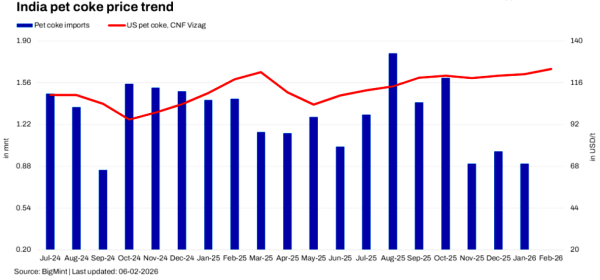
India Petroleum Coke Price Trend, Unit: USD/ton
Statistical Period: July 2024 – February 2026
Data Source: BigMint
At the beginning of February, the global petroleum coke market remained firm, with continued procurement from the Mediterranean and India supporting mid- to high-sulfur grades (sulfur content 5.5%–6.5%). Price discovery mechanisms across regions have been operating smoothly, and India, driven by freight costs, regulatory restrictions, and rigid demand from the cement industry, continues to anchor the upper end of the global price curve.
Although Indian cement producers are optimizing their fuel mix, affecting substitution between coal and petroleum coke, the ongoing expansion of cement capacity, firm demand, and limited short-term supply continue to keep petroleum coke quotations elevated, without exerting downward pressure on prices.
Overview of Global Petroleum Coke Prices by Sulfur Content and Region
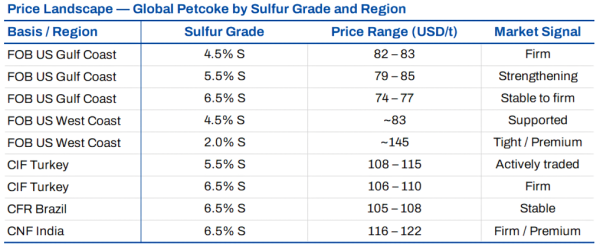
Note: Typical vessel cargo volume: approximately 50,000–55,000 tons; cargoes mainly sourced from the United States.
Latest Market Developments
India remains the highest-priced market among major destinations for fuel-grade petroleum coke imports. From late January to early February 2026, India's CFR petroleum coke offers consistently held within the range of USD 121–122/ton, while buyer bids were mostly in the range of USD 116–118/ton. Prices did not decline and remained stable.
Multiple cement procurement sources reported that petroleum coke offers remained unchanged during this period. Although some buyers attempted to push bids lower, sellers maintained firm quotations. Market sources indicated that U.S.-origin petroleum coke offers remained firm, with East Coast cargoes generally quoted higher than those from the West Coast.
It is worth noting that although some companies strategically increased the proportion of thermal coal in their fuel mix to reduce costs, overall market sentiment did not show a clear weakening trend. Some market participants pointed out that geopolitical risks and freight volatility have strengthened sellers' pricing discipline. Others suggested that potential adjustments to tariff policies between the U.S. and India later in the year could affect petroleum coke prices, but no short-term disruptions are currently observed.
In the Mediterranean market, Turkey recorded the highest trading activity. For petroleum coke with 5.5% sulfur content, CFR bid prices continued to converge within USD 108–110/ton, which has become the prevailing transaction range. Some sellers attempted to raise offers to around USD 115/ton in an effort to extend the upward trend, but faced clear resistance from buyers above that level.
Supported by stable export demand, FOB prices of petroleum coke across various sulfur grades along the U.S. Gulf Coast have remained firm. Meanwhile, low-sulfur petroleum coke supply continues to face structural tightness. On the U.S. West Coast, FOB prices for 2% sulfur petroleum coke have approached USD 145/ton, with supply-side constraints remaining pronounced.
Market Outlook: Petroleum Coke Prices to Remain Strong with Range-Bound Fluctuations
India's CFR prices are highly likely to remain within USD 118–122/ton, with limited room for sellers to soften offers;
Turkey will likely continue to serve as the marginal clearing market for U.S.-origin petroleum coke;
Affected by structural supply tightness, low-sulfur petroleum coke will continue to maintain a significant premium;
Unless freight rates or cement demand decline sharply, downside risks for petroleum coke prices remain limited.
The current trend in the global petroleum coke market is not primarily driven by sharp fluctuations in demand, but rather by cost optimization considerations within an expanding cement industry. Although Indian cement enterprises dynamically adjust their fuel mix in response to coal price changes, capacity expansion, firm cement demand, and sellers' pricing discipline jointly support petroleum coke prices at elevated levels. Petroleum coke is no longer merely a by-product fuel, but a strategic tool for cost control, and India has consequently anchored the global price center for petroleum coke.
Feel free to contact us anytime for more information about the petroleum coke market. Our team is dedicated to providing you with in-depth insights and customized assistance based on your needs. Whether you have questions about product specifications, market trends, or pricing, we are here to help.
No related results found




0 Replies