




【Graphite Electrodes】Affecting 17% of Export Volume! Analysis of the Impact of the Iran Situation...

【Graphite Electrodes】Affecting 17% of Export Volume! Analysis of the Impact of the Iran Situation on China's Electrode Market
Affected by the Spring Festival holiday, market trading in February was basically stagnant, showing a typical "dormant state." Downstream steel enterprises had completed stockpiling before the holiday, and logistics transportation was largely suspended, resulting in only sporadic transactions in the market, with prices mostly continuing the pre-holiday levels. Looking at the overall trend of the month, the market was characterized by weak supply and demand, strong cost support, and stable prices. After the Spring Festival, as the market gradually resumes work and production and steel mills restart procurement activities, while overseas conditions remain volatile and the U.S.–Iran conflict escalates, how will the graphite electrode market develop in March? The author analyzes the situation from the following aspects.
I. Price Review
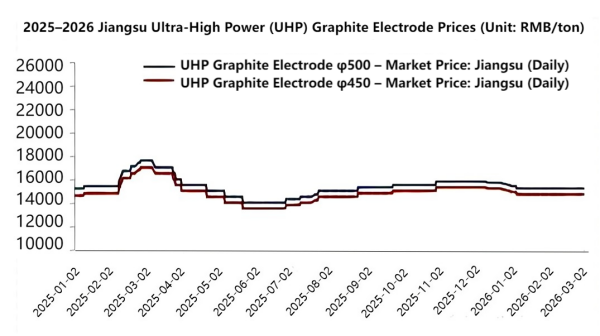
In February 2026, China's ultra-high power (UHP) graphite electrode market showed a mainly stable trend under the dual influence of "weak demand" and "strong costs." Due to the Spring Festival holiday (February 15–23), the market entered the traditional off-season for trading. Most downstream electric arc furnace (EAF) steel mills suspended production for the holiday, reducing procurement demand for graphite electrodes to the lowest point of the year.
Taking the Jiangsu market as an example, φ450 UHP graphite electrodes were quoted at RMB 14,700/ton, φ500 UHP graphite electrodes at RMB 15,200/ton, and φ600 UHP graphite electrodes at RMB 16,200/ton. Prices remained stable before and after the Spring Festival.
II. Rising Raw Material Prices Provide Cost Support
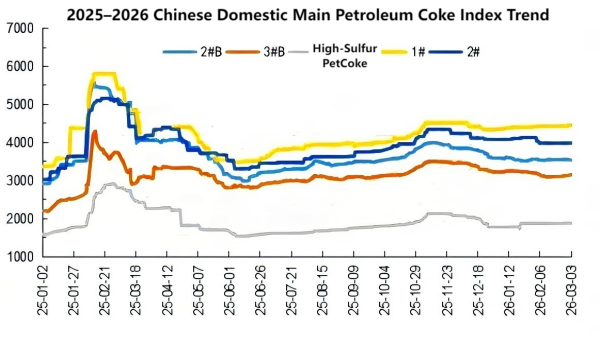
Since mid-January, the raw materials for graphite electrodes—coal tar pitch and petroleum coke—have both shown an upward trend. This has restrained the downward movement of graphite electrode prices before the holiday and laid the foundation for stable prices in February. In addition, with the escalation of overseas geopolitical conflicts, expectations for rising petroleum coke prices have strengthened.
The specific increases in raw material prices are shown in the table below:
III. Steel Mill Restocking in March May Drive Recovery in Rigid Demand
From the perspective of downstream demand, integrated steel mills maintained relatively stable operating rates during the Spring Festival period, and crude steel production continued at levels similar to those before the holiday. Therefore, the demand for refining graphite electrodes in crude steel production remained relatively stable.
Secondly, independent electric arc furnace steel mills in China experienced more obvious shutdowns during the Spring Festival period. According to a survey conducted by Mysteel on the 24th among 94 independent EAF steel mills nationwide, the average operating rate was 9.85%, and the average capacity utilization rate was 7.35%, down 18.41% and 13.66% respectively from the previous period. Procurement demand for graphite electrodes fell to the lowest point of the year. Most independent EAF mills plan to resume operations after the Lantern Festival (March 3). Therefore, the increase in steel mill procurement in March is expected to drive a rebound in rigid restocking demand for graphite electrodes.
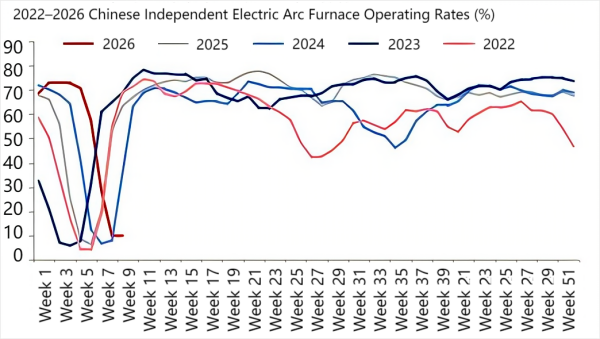
It is worth noting that, on the one hand, due to the influence of certain meetings in March, graphite electrode consumption in northern China may slow down somewhat, and the procurement pace of steel mills may be delayed. On the other hand, after the market reopened following the Spring Festival, independent EAF profits were not favorable. According to data on the 26th, the daily profits of independent EAF steel mills producing construction steel—both under valley electricity pricing and under saturated production—were in a loss-making state, which may to some extent slow the pace of EAF mills resuming production.
IV. Escalation of the U.S.–Iran Conflict
Reduction in exports
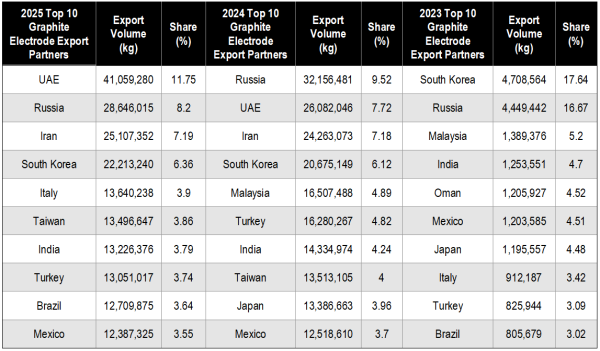
From the perspective of graphite electrode exports, since 2024, the Iranian and UAE markets have become important export destinations for China's graphite electrodes, showing an upward trend from 2024 to 2025. In the past two years, exports of graphite electrodes to Iran accounted for more than 7% of total exports, while exports to the UAE accounted for around 10% of the total.
After the escalation of the U.S.–Iran conflict, the closure of the Strait of Hormuz has had a significant impact on graphite electrode exports to both Iran and the UAE. Based on estimates from the export volume to these two countries in March 2025, the disruption could affect approximately 6,000 tons of graphite electrode exports.
Top Ten Graphite Electrode Export Destinations in the Past Three Years
Data source: Mysteel data
V. Conclusion
With the end of the Spring Festival holiday, downstream EAF steel mills will resume production on a large scale, bringing a wave of rigid restocking demand. This is expected to end the situation of "weak supply and demand" seen in February. Market activity will increase significantly, and trading volume is expected to grow month-on-month.
However, affected by the U.S.–Iran conflict, export pressure may shift toward the domestic Chinese market. In the short term, the upward momentum in raw material prices may be difficult to fully offset quickly. Therefore, the graphite electrode market in March is expected to show a moderate recovery trend, with prices rising slightly.
Feel free to contact us anytime for more information about the EAF Steel market. Our team is dedicated to providing you with in-depth insights and customized assistance based on your needs. Whether you have questions about product specifications, market trends, or pricing, we are here to help.
No related results found




0 Replies