




【International】U.S.–Iran Conflict Continues, Petroleum Coke Prices Likely to Rise Rather Than Fall

Calcined petroleum coke, with its high carbon content, low sulfur, and low impurities, plays a vital role in modern manufacturing, especially in the aluminum and steel industries.
【International】U.S.–Iran Conflict Continues, Petroleum Coke Prices Likely to Rise Rather Than Fall
On February 28, 2026, the United States and Israel jointly launched large-scale military strikes against mainland Iran. Iran subsequently announced the closure of the Strait of Hormuz, sharply escalating geopolitical tensions in the Middle East and pushing the region into prolonged instability. As the "chokepoint" of global energy transportation, the Strait of Hormuz carries approximately 30% of the world's seaborne oil trade. Its closure has directly triggered a severe physical disruption in the global energy supply chain, causing international oil prices to surge significantly, while shipping costs and insurance premiums have risen sharply, greatly increasing uncertainty in the energy market. Petroleum coke, a key raw material for prebaked anodes used as auxiliary material in aluminum electrolysis, is expected to face a triple pressure of tightening supply, soaring costs, and quality disturbances due to the transmission effects of geopolitical tensions. This development will directly impact the stability of China's petroleum coke import system and significantly raise the production cost of domestic prebaked anodes, creating a cascading effect on the downstream aluminum smelting industry.
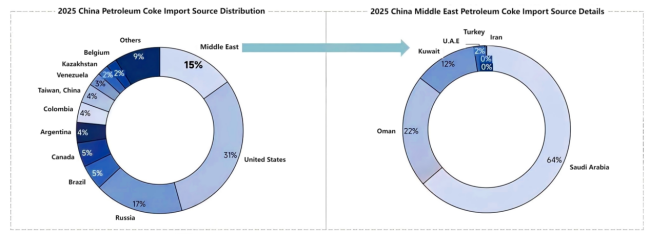
From the perspective of overall import source distribution, China's petroleum coke imports in 2025 show a tiered structure among major supplying regions and countries. The first tier is dominated by the United States and Russia. The United States accounts for as much as 31%, making it China's largest source of petroleum coke imports, followed by Russia with a 17% share. Together, these two countries contribute nearly half of the total import volume. The second tier consists of the Middle East, which accounts for 15% and serves as an important supplementary supply region for China's petroleum coke imports. The remaining sources are relatively dispersed, with Canada and Brazil each accounting for 5%, while Argentina, Colombia, and Taiwan (China) each account for 4%. These diversified smaller suppliers further enrich China's petroleum coke import system, though the influence of any single supplier among them remains relatively limited.
It is worth noting that the Middle East, as a key supplementary region for China's petroleum coke imports, has a highly concentrated internal supply structure. This concentration is the core reason why the deterioration of the current geopolitical situation has such a strong impact on China's import market. Looking at detailed import sources within the Middle East, the supply pattern shows a clear feature of "one dominant supplier with a few supplementary ones." Saudi Arabia holds an absolute leading position with a 64% share, making it the primary exporter of petroleum coke from the Middle East to China. Oman ranks second with a 22% share, followed by Kuwait with 12%, while other regions contribute only marginal volumes. In terms of product specifications, petroleum coke imported from the Middle East to China mainly consists of medium- to high-sulfur varieties, with different source countries specializing in different product types. Petroleum coke imported from Saudi Arabia mainly includes high-sulfur sponge coke and high-sulfur shot coke; imports from Oman are mainly shot coke; and imports from Kuwait are mainly medium-sulfur sponge coke. These types of petroleum coke are primarily used in blending for the production of prebaked anodes and serve as an important raw material supplement for China's prebaked anode industry.
The closure of the Strait of Hormuz has multidimensional transmission effects on the petroleum coke market:
On the one hand, the blockade of the strait has led to a complete halt in petroleum coke exports from the Middle East, significantly reducing the circulation of international petroleum coke supply. The delivery cycle for petroleum coke imported from the Middle East to China has been significantly extended, directly intensifying the tightness of domestic import supply.
On the other hand, some refineries within the region have experienced disruptions to their operations due to military conflict, restricting production activities and further reducing overall petroleum coke supply, creating a dual squeeze on the supply side.
At the same time, the surge in international oil prices has driven up production costs for petroleum coke from refinery delayed coking units, providing strong bottom support for petroleum coke prices. In addition, the sharp rise in international shipping freight rates and war-risk insurance premiums further pushes petroleum coke prices into a trajectory where they are more likely to rise than fall.
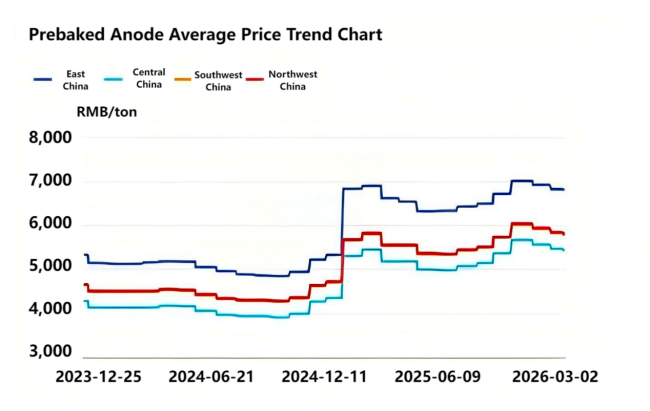
In summary, the current geopolitical conflict in the Middle East represents a major external shock to the petroleum coke – prebaked anode – aluminum electrolysis industrial chain in 2026. The triple pressures of tightening supply, soaring costs, and quality disturbances will continue to transmit downstream: petroleum coke prices will continue to rise, prebaked anode production costs will be passively pushed upward, and aluminum electrolysis production costs will consequently increase.
If the closure of the Strait of Hormuz continues, the entire industrial chain will gradually enter an operating phase characterized by high costs, low inventories, and strong volatility, making supply chain security and corporate cost control the key challenges facing the industry.
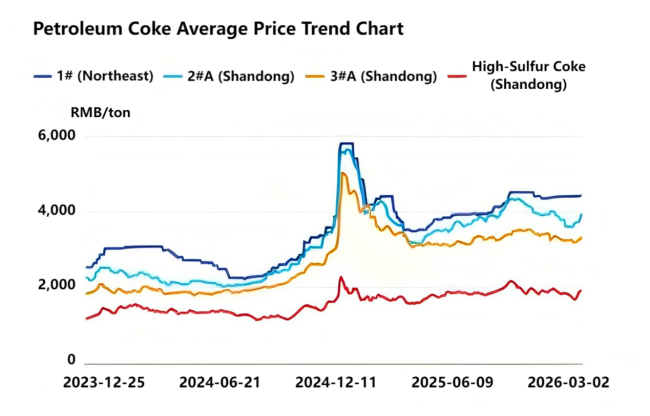
Shandong regional petroleum coke quotations by specification.
Unit: RMB/ton

Feel free to contact us anytime for more information about the petroleum coke market. Our team is dedicated to providing you with in-depth insights and customized assistance based on your needs. Whether you have questions about product specifications, market trends, or pricing, we are here to help.
No related results found




0 Replies