




【Steel】China's Low-Carbon Steel Path

Graphite electrodes are the "lifeline" of EAF steelmaking! As the core material for arc conduction and heating, they feature high conductivity and heat resistance, directly affecting molten steel quality and output. Mastering graphite electrodes means mastering the initiative in EAF steelmaking!
【Steel】China's Low-Carbon Steel Path
China's green transition policy is consistent and relies on strong economic potential.
At present, China's steel output accounts for 55% of global steel production, while its greenhouse gas emissions account for more than 60% of the global steel industry. Therefore, the success or failure of China's decarbonization goals is directly relevant. Currently, producing 1 ton of finished rolled steel in China generates 2.33 tons of CO₂ emissions, compared with the global average of 1.92 tons. Therefore, China has enormous decarbonization potential. As part of Beijing's climate policy, this potential is gradually being realized. China aims to achieve a series of ambitious targets in 2020, so the effectiveness of decarbonization will largely depend on this year's results.
Green Government Policies
In 2020, the Chinese government introduced the "1+N" national emission reduction framework, aiming to achieve net-zero CO₂ emissions by 2060. As part of this strategy, China's national greenhouse gas emissions trading system (ETS CH) has been officially in operation since July 2021. Currently, the system covers about 35% of China's CO₂ emissions, of which around 35% comes from the energy sector.
So far, 2,162 power companies have participated in ETS CH, accounting for 99.5% of all market participants. From 2022 to 2024, the total quota trading volume reached 634 million tons, with a cumulative market value of USD 6.06 billion. In 2024 alone, 188 million tons were traded, worth USD 2.52 billion.
In March this year, China's Ministry of Ecology and Environment announced that preparations for expanding the emissions trading system (ETS) have been completed. Liu Shizhe, a representative of the ministry, stated that from 2025 to 2026, eight new industries will be added to the national greenhouse gas quota market, including the steel industry, which accounts for 17% of China's CO₂ emissions.
As in the energy sector, emission allowances will initially be allocated to enterprises free of charge. In the future, the total quota will be reduced, which will lead to rising emission prices. Currently, the cost of emission allowances for energy enterprises is USD 12.5 per ton of CO₂. In 2022, the trading price dropped to USD 7.4 per ton. The introduction of a paid CO₂ emission system, combined with gradually increasing emission prices, will become an important driving force for decarbonization in China's steel industry.
Among other regulatory measures, the "Special Action Plan for Energy Saving and Emission Reduction in the Steel Industry," approved by the National Development and Reform Commission (NDRC) in July 2024, outlines several notable measures.
It is well known that the Chinese government regularly restricts steel capacity utilization for environmental reasons, particularly to control smog. According to NDRC decisions, this does not apply to steel enterprises that have reached Class A emission standards.
Government authorities are empowered to restrict or even completely ban the export of high-energy-consumption steel products, while giving priority to low-energy-consumption products.
The issuance of construction permits for new steel plants that do not meet requirements for coal consumption reduction and substitution, regional reduction, and total emission control is prohibited.
In addition, electricity prices will be increased for steel enterprises with environmental performance rated at Class C and D. Through these mechanisms, the NDRC aims to achieve the following targets by the end of 2025:
· Compared with 2023, reduce electricity consumption per ton of hot metal and steel in BF-BOF plants by 1%;
·Reduce electricity consumption per ton of steel in EAF steelmaking by 2%;
· Reduce coal consumption by 20 million tons and CO₂ emissions by 53 million tons compared with 2023.
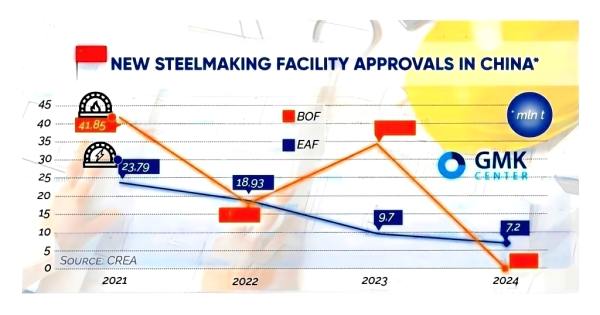
It is worth noting that as early as 2024, authorities did not approve any new blast furnace–basic oxygen furnace (BF-BOF) projects. According to the Centre for Research on Energy and Clean Air, only permits for electric arc furnace (EAF) plants with a total capacity of 7.2 million tons per year were issued.
Therefore, the Chinese government is continuously promoting the green transformation of domestic steel enterprises. This primarily includes the introduction of energy-saving technologies, digital transformation, and shifting away from low-grade iron ore toward high-grade iron ore.
These are urgent changes. In the medium term, the plan is to reduce carbon emissions by shifting to scrap-based electric arc furnace production.
"Shortcut"
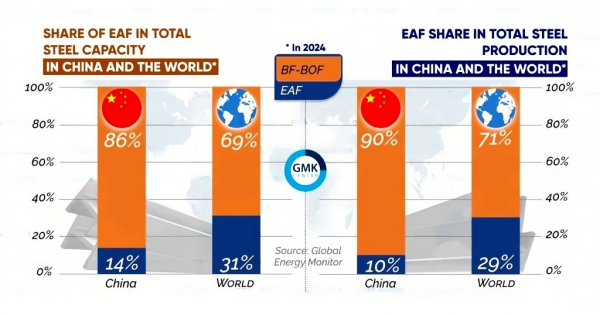
Electric arc furnace (EAF) steelmaking in China is referred to as the "short route." Currently, it can be considered a niche segment of China's steel industry. At the same time, the utilization rate of EAFs is lower than that of BF-BOF routes. Therefore, the contribution of EAF steelmaking to China's steel output is even smaller than its share of nominal capacity.
Meanwhile, according to calculations by the climate think tank E3G, if the share of scrap-based EAF steel in total production increases to 56%, China could reduce emissions by 39% by 2050 compared with 2020. This explains the importance of this sector. However, in pursuing this "shortcut," China's steel industry faces a very serious obstacle.
Initially, authorities set a target for EAF steel to account for 20% of total output by 2025, doubling the 2023 level. This would require not only full utilization of all existing EAF plants but also the construction of new ones.
Currently, China is building EAF capacity totaling 48 million tons, while 21 million tons of inefficient EAF capacity will be shut down. This results in a net addition of 27 million tons, which is insufficient to meet the target of 200 million tons of EAF steel output this year. Therefore, the NDRC has lowered the 2025 EAF steel share target to 15% of total steel output. Achieving this requires producing 143–150 million tons of EAF steel, which is roughly equivalent to current capacity.
This indicates that the development of EAF metallurgy in China is lagging behind previously set targets. The reason lies in the shortage of scrap steel used as feedstock for EAF steelmaking. In 2024, China's scrap consumption is expected to reach 214 million tons. However, only 30% of this is used in EAF steel production, as a large portion is fed into BOF steelmaking together with hot metal.
Authorities believe that increasing scrap procurement to 300 million tons by 2025 is the way out. Driving this initiative is a government subsidy program for consumers purchasing new vehicles and home appliances. On the one hand, this increases the amount of obsolete scrap. On the other hand, it increases the workload of machinery manufacturing plants, whose production scrap is a major source of scrap collection.
In addition, in June this year, the China Iron and Steel Association (CISA) proposed that the government include scrap steel in the list of "critical materials." This would mean restricting or completely banning scrap exports.
However, even with these measures, it will not be possible to fully support a transition to scrap-based EAF production. Despite China's strong machinery manufacturing capacity and its ability to import scrap, the scale of its steel industry is even larger. Therefore, only with the help of hydrogen technology can China ultimately achieve its decarbonization goals.
Hydrogen Potential
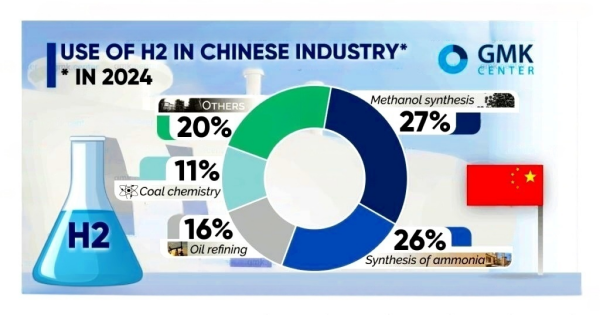
China is far ahead in industrial hydrogen applications. According to data from the National Energy Administration, hydrogen production increased by 3.5% in 2024, reaching 36.3 million tons. However, most of this is so-called "grey hydrogen" and "blue hydrogen" produced based on SMR and ATR technologies, which are not environmentally friendly. The share of green hydrogen is negligible.
Nevertheless, China has made some progress. In 2024, 35 new green hydrogen production projects were added, with a total capacity of 48,000 tons. Thus, the potential of the green hydrogen industry has reached 125,000 tons per year, accounting for 50% of global capacity.
In comparison, Europe's largest green hydrogen plant, owned by BASF in Germany, has an electrolysis capacity of 54 MW. China's largest plant — Sinopec's Kuqa green hydrogen project in Xinjiang — has a capacity of 260 MW.
In 2020, the NDRC approved the "Medium- and Long-Term Plan for Hydrogen Energy Development (2021–2035)." According to this document, by 2025, national green hydrogen production should reach 100,000 to 200,000 tons per year. In other words, hydrogen industry development is proceeding as planned, and targets are being met. Meanwhile, hydrogen application in the steel industry remains very limited.
Among the projects already in operation, it is worth mentioning the HBIS Group plant in the Zhangjiakou region, which uses hydrogen as a reducing agent to produce direct reduced iron (DRI). The plant has an annual capacity of 600,000 tons and plans to expand to 1.2 million tons. According to Italian equipment supplier Danieli, this project is the most environmentally friendly DRI production facility in the world, with CO₂ emissions of 0.25 tons per ton of product.
HBIS plans to use EAF-produced green steel and hydrogen-based direct reduced iron (H₂ DRI) to produce up to 1.5 million tons of automotive sheet. The company also plans to test carbon capture, utilization, and storage (CCUS) technologies at the plant. Preliminary estimates suggest that 0.125 tons of CO₂ can be captured per ton of DRI produced.
Also noteworthy is the 1 million ton/year H₂ DRI plant of Baosteel Zhanjiang in Guangdong Province.
Meanwhile, the National Energy Administration has noted issues with demand for green hydrogen. By the end of 2024, out of more than 600 planned green hydrogen projects, only 90 had been completed and another 80 were under construction. The reason is that the price of this product remains too high.
According to the National Energy Administration, the production cost of green hydrogen in China in 2024 was USD 3.85/kg, down 15.6% year-on-year. The end-user price also decreased by 13.7% to USD 6.69/kg. Such a large increase (nearly double the previous year) is due to high transportation costs. Although most hydrogen plants are located in northeastern China, where most steel production capacity is concentrated, prices still increased.
In other words, China's current issue is not reducing the production cost of green hydrogen itself, but finding cheaper transportation solutions. By comparison, S&P Global Commodity Insights reports hydrogen prices at USD 5.2/kg in the United States and USD 6.94/kg in the European Union. Meanwhile, Global Efficiency Intelligence estimates that under current conditions, the green premium for Chinese steel exceeds USD 225 per ton. This is too high, roughly equivalent to 50% of the cost of traditional BF-BOF steelmaking.
For example, in shipbuilding, a bulk carrier with a displacement of 40,000 tons requires about 13,200 tons of steel. Using low-carbon steel would increase the cost of each ship by USD 3 million. With an average cost exceeding USD 30 million, this represents a 10% margin — a significant impact for buyers.
In residential construction, assuming an average steel consumption of 50 kg per square meter, a standard 50 m² two-bedroom apartment would see a price increase of only USD 563. Compared with the current average price of USD 70,000 for such apartments in Chongqing, this is less than a 1% increase. Therefore, even in the current market environment, long products produced using scrap-based EAF technology have good market prospects.
Optimization Added
When assessing the potential for CO₂ emission reductions in China's steel industry, it is worth recalling a statement made by the NDRC in March this year. At that time, the NDRC stated in a report to the National People's Congress that it would "resolutely promote structural adjustment in the steel industry through production cuts."
The scale of emission reductions has not yet been determined, but industry estimates suggest about 50 million tons per year. The timeline for implementing restructuring plans has also not been specified — whether before the end of the current Five-Year Plan (this year) or by the end of the next one (2030).
Nevertheless, given that this argument has been included in official policy documents issued by China's top economic decision-making body, it indicates that a reduction in steel output is indeed forthcoming.
This can be achieved by limiting existing capacity, shutting down inefficient facilities, or combining both mechanisms. In any case, these measures will significantly reduce CO₂ emissions in China's steel industry.
Feel free to contact us anytime for more information about the EAF Steel market. Our team is dedicated to providing you with in-depth insights and customized assistance based on your needs. Whether you have questions about product specifications, market trends, or pricing, we are here to help.
No related results found




0 Replies