




【Anode Material Graphitization】Mainstream Processes and Technical Key Points

The rapid growth of the EV and energy storage industries is boosting demand for high-performance lithium batteries, driving the market for quality petroleum coke and synthetic graphite. The quality and particle size of calcined petroleum coke directly affect synthetic graphite performance, especially in anode production.
【Anode Material Graphitization】Mainstream Processes and Technical Key Points
With the rapid development of the global new energy industry, unprecedented strong demand has emerged for new energy vehicles, energy storage equipment, and consumer electronic products, leading to significant growth in the demand for graphite anode materials. As a key material for lithium-ion batteries, graphite anode materials have gradually become the mainstream choice in the anode material market, accounting for approximately 70% of the market share. The graphitization process of artificial graphite anode materials is both a key factor affecting material quality and a technical challenge. This article discusses the mainstream graphitization processes and key technical points based on personal experience and understanding, hoping to provide reference value for the graphitization production of artificial graphite anode materials.
1 Graphitization
The graphitization process fully utilizes resistance heat to heat carbon materials to 2300–3000 ℃, transforming amorphous turbostratic carbon structures into ordered graphite crystal structures. The energy source for graphite crystal transformation and atomic rearrangement comes from high-temperature heat treatment. As the heat treatment temperature increases, the graphite interlayer spacing gradually decreases, generally reaching between 0.343–0.346 nm. Significant changes usually occur at around 2500 ℃, while changes gradually slow at 3000 ℃ until the entire graphitization process is completed. Artificial graphite anode materials obtain the corresponding functions required for lithium battery anodes precisely through this high-temperature graphitization treatment, which converts carbon structures into graphite structures.
2 Mainstream Furnace Types and Processes for Anode Material Graphitization
Currently, the main furnace types used in the graphitization process of anode materials include the Acheson graphitization furnace, internal heating graphitization furnace, box-type graphitization furnace, and continuous graphitization furnace. Among them, the Acheson graphitization furnace is the most widely used, while the internal heating graphitization furnace is used to a lesser extent. The box-type graphitization furnace and continuous graphitization furnace are newly developed furnace types in recent years. The box-type graphitization furnace has developed rapidly, mainly through modifications of Acheson furnaces and partial new construction. Continuous graphitization furnaces are all newly built and still in the experimental stage; their furnace structures and processes are not yet fully mature, and widespread commercial application still requires time. Due to significant differences in loading methods, production processes, and auxiliary material usage among various furnace types, the quality of anode materials produced by different furnace types also shows obvious differences (Table 1 and Table 2).
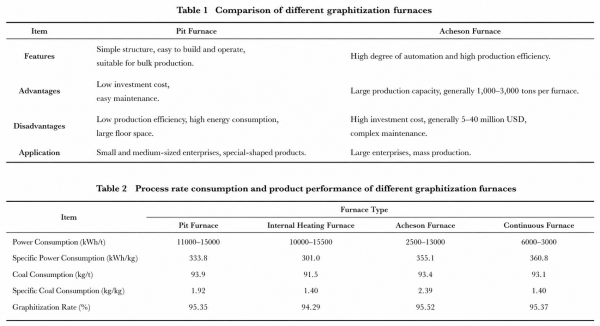
The Acheson furnace loads carbonaceous anode materials into single-hole crucibles (one-hole crucibles), which are then placed into the graphitization furnace. Resistance materials are inserted between crucibles to provide resistance heating. Insulation materials are added on both sides and the top cover, and graphitization is completed through power transmission. The internal heating graphitization furnace loads carbonaceous anode materials into multi-hole crucibles (9-hole crucibles), which are then connected end-to-end in series and loaded into the graphitization furnace. Insulation materials are added on both sides and the top cover, and graphitization is completed through power transmission. The box-type graphitization furnace directly loads carbonaceous anode materials into large boxes pre-installed with carbon plates or graphite plates, then adds carbon or graphite cover plates as resistance materials. Insulation materials are added on the top and both sides, and graphitization is completed through power transmission. The continuous graphitization furnace continuously feeds carbonaceous anode materials into the graphitization furnace chamber, where they undergo high-temperature graphitization and are then cooled and discharged.
3 Technical Key Points in the Processes of Different Graphitization Furnaces
The processing of anode materials mainly includes two key stages: granulation and graphitization, both of which have high technical barriers. Through graphitization, the specific capacity, initial efficiency, specific surface area, compaction density, conductivity, and chemical stability of anode materials can be significantly improved. Therefore, controlling and mastering graphitization process technology is an important means of ensuring anode material quality. Since the processes of box-type furnaces and continuous graphitization furnaces are not yet fully mature, the following discussion mainly introduces the process key points of Acheson furnaces and internal heating graphitization furnaces.
3.1 Loading of Acheson Furnaces and Internal Heating Furnaces (Crucibles)
3.1.1 Matching of Volatile Matter During Furnace Loading
When the temperature inside the graphitization furnace rises to 200–1000 ℃, a large amount of volatile matter is released from the anode materials. If these volatiles cannot be discharged in time, accumulation may occur, causing dangerous furnace eruption accidents. During massive volatile release, incomplete combustion can generate a large amount of black smoke, resulting in environmental pollution or environmental protection incidents. Therefore, the following points should be noted during furnace loading:
(1) During loading, anode materials should be reasonably matched according to volatile matter content to avoid excessive concentration and simultaneous release of high-volatile materials during power transmission;
(2) Appropriate ventilation holes should be set in the top insulation materials to facilitate effective volatile discharge;
(3) When designing the power transmission curve, the concentrated volatile release stage should be fully considered, and the curve should be appropriately slowed to ensure gradual discharge and full combustion of volatiles;
(4) Auxiliary materials should be reasonably selected, and their particle size composition should be controlled to reduce the amount of 0–1 mm fine powder, generally maintaining a proportion ≤10%.
3.1.2 Uniform Furnace Resistance During Loading
When anode materials and resistance materials are unevenly distributed inside the furnace, electric current tends to flow through areas with lower resistance, causing current deviation and affecting the graphitization effect of the entire furnace load. Therefore, the following points should be noted during loading:
(1) Resistance materials should be distributed continuously from the head to the tail of the furnace chamber to avoid concentration of either fine or coarse particles;
(2) When loading new and old crucibles into the same furnace, reasonable matching is also required. It is prohibited to load one layer of new crucibles and one layer of old crucibles alternately;
(3) Avoid exposing resistance materials into the sidewall materials.
3.2 Power Transmission in Acheson Furnaces and Internal Heating Furnaces
3.2.1 Basis for Formulating the Power Curve During Power Transmission
According to different quality requirements of anode materials, graphitization can be divided into low-temperature material (2800 ℃), medium-temperature material (2950 ℃), and high-temperature material (3000 ℃). However, the graphitization heat treatment process generally occurs between 2250–3000 ℃. To ensure that all positions inside the furnace reach the required temperature, the high-temperature stage must be maintained for a certain period to ensure temperature uniformity throughout the furnace. Normally, depending on the furnace type, the holding time differs, generally ranging from 6–30 hours. During power transmission, 3–6 hours are required to prevent furnace resistance rebound. Specific conditions should be determined according to the following technical points:
(1) Different heating curves should be selected according to the furnace core, anode material, resistance material, crucible type, and loading quantity;
(2) Different curves should be selected according to the volatile content of anode materials and resistance materials. If the volatile content is high, a slower heating curve should be selected; otherwise, a faster heating curve can be used;
(3) If the ash content of anode materials and resistance materials is high or the materials are relatively difficult to graphitize, the duration of high-power transmission should be appropriately extended.
3.2.2 Prevention of Furnace Eruption Accidents During Power Transmission
Since anode materials are powder materials with high volatile content that are difficult to discharge, electric arcs and furnace eruption accidents caused by high volatile content are likely to occur. The following points should be noted during operation:
(1) During loading in Acheson furnaces, resistance materials should be compacted to prevent suspended resistance materials between crucibles during power transmission, which may generate electric arcs and cause furnace eruptions;
(2) During power transmission in internal heating furnaces, displacement changes mainly involve shrinkage. Therefore, when loading anode materials, the hydraulic cylinder stroke should be calculated to ensure sufficient travel and pressure during power transmission, avoiding pressure loss that could lead to electric arc furnace eruptions;
(3) Both furnace types should select coarse-particle auxiliary materials with lower volatile content;
(4) During power transmission, close attention should be paid to any localized heating phenomena in the furnace chamber;
(5) During power transmission, close attention should be paid to any flame leakage from the furnace top or walls;
(6) During power transmission, close attention should be paid to any low roaring sounds inside the furnace chamber;
(7) During power transmission, close attention should be paid to large fluctuations in current.
If any phenomena listed in items (4)–(7) occur during power transmission, power should be shut down immediately for handling to avoid furnace eruption accidents.
3.3 Cooling and Furnace Discharge
(1) During the graphitization cooling process, forced water cooling should not be used for anode materials. Instead, grab buckets or suction devices may be used to remove materials layer by layer for natural cooling.
(2) It is optimal to remove anode material crucibles from the furnace at around 150 ℃. Premature removal may lead to oxidation of anode materials due to excessive temperature, increasing specific surface area and causing oxidation damage to crucibles, thereby increasing costs. Excessively delayed removal may also oxidize the anode powder materials, increase specific surface area, extend production cycles, and increase costs.
(3) Under graphitization temperatures of 3000 ℃, all elements except carbon are vaporized and discharged. However, a small amount of impurities may still adsorb onto the surface of anode materials during cooling. As a result, a rough hard shell layer forms on the surface of the crucible contents during furnace discharge. Materials with high ash content and high volatile content produce more hard shell materials. This is also why low-ash and low-volatile auxiliary materials are preferred.
(4) The hard shell material differs significantly in performance indicators from qualified anode materials. Therefore, when removing crucibles, the 1–5 mm thick hard shell layer should first be removed and stored separately. Qualified materials with smooth surfaces should then be collected normally, loaded into jumbo bags, stored, and shipped to customers.
Source: Carbon Techniques
Feel free to contact us anytime for more information about the Anode Material market. Our team is dedicated to providing you with in-depth insights and customized assistance based on your needs. Whether you have questions about product specifications, market trends, or pricing, we are here to help.
No related results found




0 Replies