

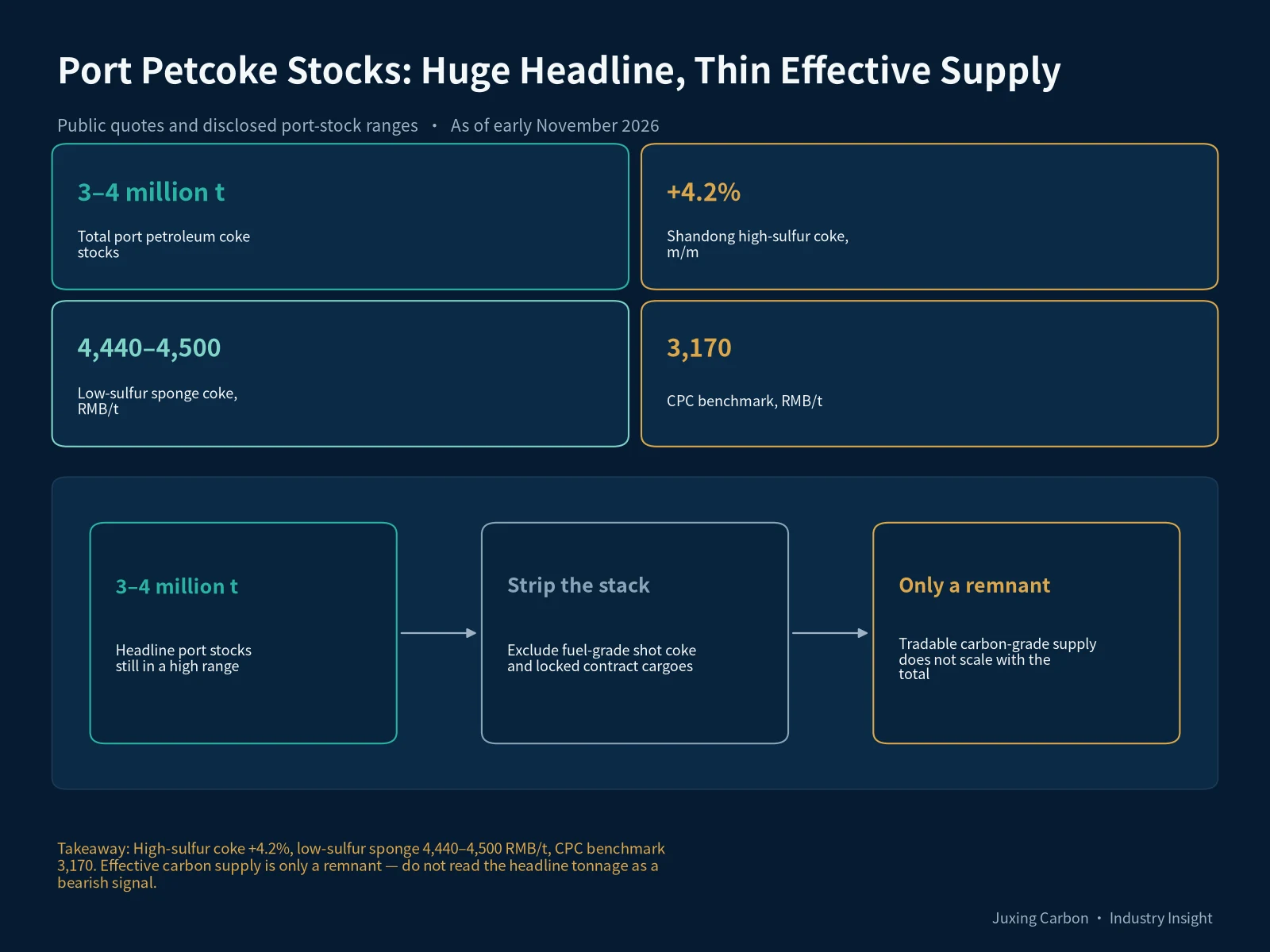
Behind the headline 3 to 4 million tons of port petroleum coke inventory lies a sharp structural divide: the vast majority consists of fuel-grade shot coke and underwater trader positions, while usable carbon-grade sponge coke is quickly snapped up for blending.
A striking divergence currently defines China’s petroleum coke market. On paper, total imported petroleum coke inventories across major Chinese ports remain elevated at 3 to 4 million tons. Yet in the physical market, domestic high-sulfur sponge coke in Shandong recently climbed 4.2% month-on-month, low-sulfur sponge coke holds firmly at 4,440–4,500 RMB/ton, and independent calciners struggle to cover costs even at the 3,170 RMB/ton calcined petroleum coke (CPC) benchmark. Reconciling high port stockpiles with firm feedstock prices requires breaking down the physical composition of dockside inventories.
Inventory Composition
Data basis: Public market quotes and disclosed port-inventory ranges as of early November 2026.
First, a massive share of port tonnage consists of high-sulfur, high-ash, high-volatile fuel-grade petroleum coke—most notably dense, spherical "shot coke." Produced from heavy sour crudes at overseas refineries, shot coke exhibits high thermal expansion, poor binding properties, and elevated vanadium and nickel levels. While suitable as boiler fuel for power plants, cement kilns, and glassworks, shot coke cannot be fed in significant ratios into carbon calciners or forming presses without causing severe cracking or rapid oxidation during downstream electrolysis. Fuel-grade shot coke on the docks has zero substitutability for carbon-grade feedstock.
| Item | Public range or quote | What it shows |
|---|---|---|
| Total port petroleum coke stocks | 3 to 4 million tons | Headline inventories remain elevated |
| Shandong high-sulfur coke | About +4.2% month-on-month | Spot prices diverge from the aggregate stockpile |
| Low-sulfur sponge coke | 4,440–4,500 RMB/ton | Holds at a high range |
| CPC benchmark | 3,170 RMB/ton | Independent calciners still face cost pressure |
Note: Figures are taken from the source ranges and quotes; the headline total is a range, not a later channel's precise tonnage.
Effective Supply
Second, usable imported carbon-grade sponge coke clears the docks rapidly. Because calcining 100% domestic sponge coke at the standard 1.28 yield factor pushes raw material costs past 3,072–3,200 RMB/ton, domestic calciners and carbon plants rely heavily on 20%, 30%, or even 100% imported sponge coke blends to stay competitive. Consequently, imported sponge coke cargoes with suitable sulfur and trace-metal profiles are either pre-allocated under long-term contracts or purchased immediately upon vessel arrival.
Once unburnable fuel-grade shot coke and pre-committed blending cargoes are excluded, much of the remaining port inventory consists of high-cost "zombie cargoes" acquired by traders at previous market peaks who refuse to liquidate at deep losses. The actual volume of freely tradable, cost-effective imported sponge coke capable of replacing domestic carbon feedstock represents only a small fraction of total port stocks.
| Cargo type | Usable as carbon feedstock | Clearance or status |
|---|---|---|
| Fuel-grade shot coke | No — not for calciners or forming presses | Cannot convert into carbon-grade supply at any scale |
| On-spec imported sponge coke | Yes — used in 20%, 30%, or even 100% blends | Pre-committed or lifted quickly after arrival |
| High-cost cargoes held at a loss | Hard to offer as spot supply | Locked in unsold positions |
| Freely tradable effective supply | Available now and able to replace domestic sponge coke | Only a small fraction of apparent port stocks — a remnant |
Note: The source does not state a specific effective-inventory tonnage, so none is inferred here.
Procurement Implications
For carbon procurement teams, relying on aggregate port tonnage as a bearish signal is misleading. Effective market analysis requires separating fuel-grade shot coke from carbon-grade sponge coke and tracking the true availability of furnace-ready feedstock.