

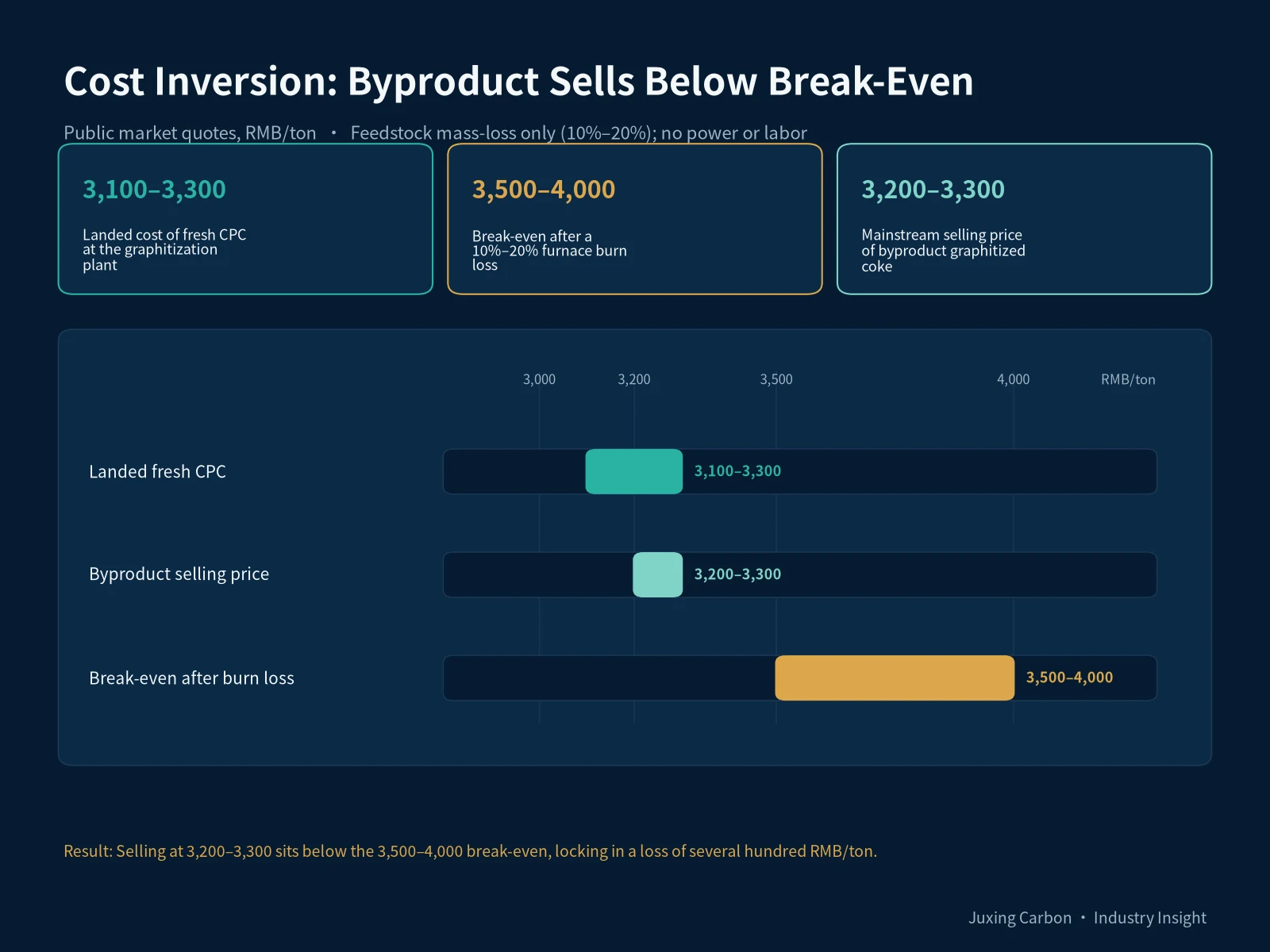
Facing landed calcined petroleum coke (CPC) costs of 3,100–3,300 RMB/ton and a 10%–20% furnace burn loss against byproduct selling prices of just 3,200–3,300 RMB/ton, anode graphitization plants are recycling their own byproduct coke in-house, sharply reducing virgin CPC consumption.
Despite a 53% year-on-year surge in China’s September lithium-ion anode output to 369,500 tons (and 2.7312 million tons across the first nine months), upstream suppliers of calcined petroleum coke (CPC) used as furnace insulation and resistor media continue to report sluggish new-order intake. A straightforward mass-balance and cost calculation across the 3,000°C graphitization furnace explains why booming downstream operating rates have failed to lift virgin CPC demand.
Cost Inversion
Data basis: Public market quotes as of early November 2026 and anode output data for the first three quarters.
At current market levels, standard CPC is priced around 3,000 RMB/ton ex-works (with public benchmark indices near 3,170 RMB/ton). Adding 100 to 300 RMB/ton in freight puts the landed cost of fresh CPC at the graphitization plant between 3,100 and 3,300 RMB/ton. Once loaded into a 3,000°C graphitization furnace as packing or resistor medium, further devolatilization, desulfurization, and handling oxidation result in a physical weight loss of 10% to 20%.
Even if zero electricity or labor costs are allocated to the auxiliary medium, simply recovering that 10% to 20% mass loss requires the resulting byproduct graphitized coke to sell for at least 3,500 to 4,000 RMB/ton to break even on feedstock cost alone. Yet because cumulative nine-month anode production has reached 2.7312 million tons, vast volumes of byproduct graphitized coke have flooded the spot market, pinning mainstream selling prices at just 3,200 to 3,300 RMB/ton (with premium lots capping out near 3,800 RMB/ton). Selling byproduct coke into the open market while refilling furnaces with 100% fresh CPC therefore locks in a net loss of several hundred RMB per ton.
| Item | Price or rate | What it means |
|---|---|---|
| Landed cost of fresh CPC | 3,100–3,300 RMB/ton | About 3,000 ex-works plus 100–300 freight |
| Furnace burn loss | 10%–20% | Devolatilization, sulfur removal, handling oxidation |
| Break-even selling price | 3,500–4,000 RMB/ton | Mass-loss recovery only; no power or labor |
| Mainstream byproduct quote | 3,200–3,300 RMB/ton | Selling 100% fresh-CPC output locks in a loss |
Note: Prices are the public quotes already given in the source text. Premium lots cap out near 3,800 RMB/ton; break-even covers the 10%–20% weight loss only.
Internal Recycling
With the anode industry’s own average gross margin compressed by 40.78% month-on-month to 555.01 RMB/ton, graphitization workshops have responded by switching to closed-loop internal recycling. Instead of buying full furnace loads of virgin CPC, plants screen the byproduct graphitized coke discharged from the previous furnace run and feed it directly back into the next furnace as insulation medium—purchasing only a small top-up of fresh CPC to cover the 10%–20% burn loss.
| Path | Fresh CPC intake | Result |
|---|---|---|
| Buy a full load, sell the byproduct | 100% virgin CPC | A loss of several hundred RMB/ton |
| Recycle byproduct in-house | Top up only the 10%–20% loss | Virgin CPC unit consumption falls |
Note: Plants screen byproduct coke from the previous run and feed most of it back as insulation medium; the table does not invent a purchase volume.
Procurement Implications
Meanwhile, the portion of byproduct graphitized coke that does enter the spot market at 3,200–3,300 RMB/ton offers higher fixed carbon and lower sulfur than 3,000–3,170 RMB/ton CPC at virtually the same price, prompting external buyers to blend it in place of standard CPC. Until the spread between virgin CPC and byproduct graphitized coke normalizes, internal recycling will continue to cap fresh CPC procurement.