

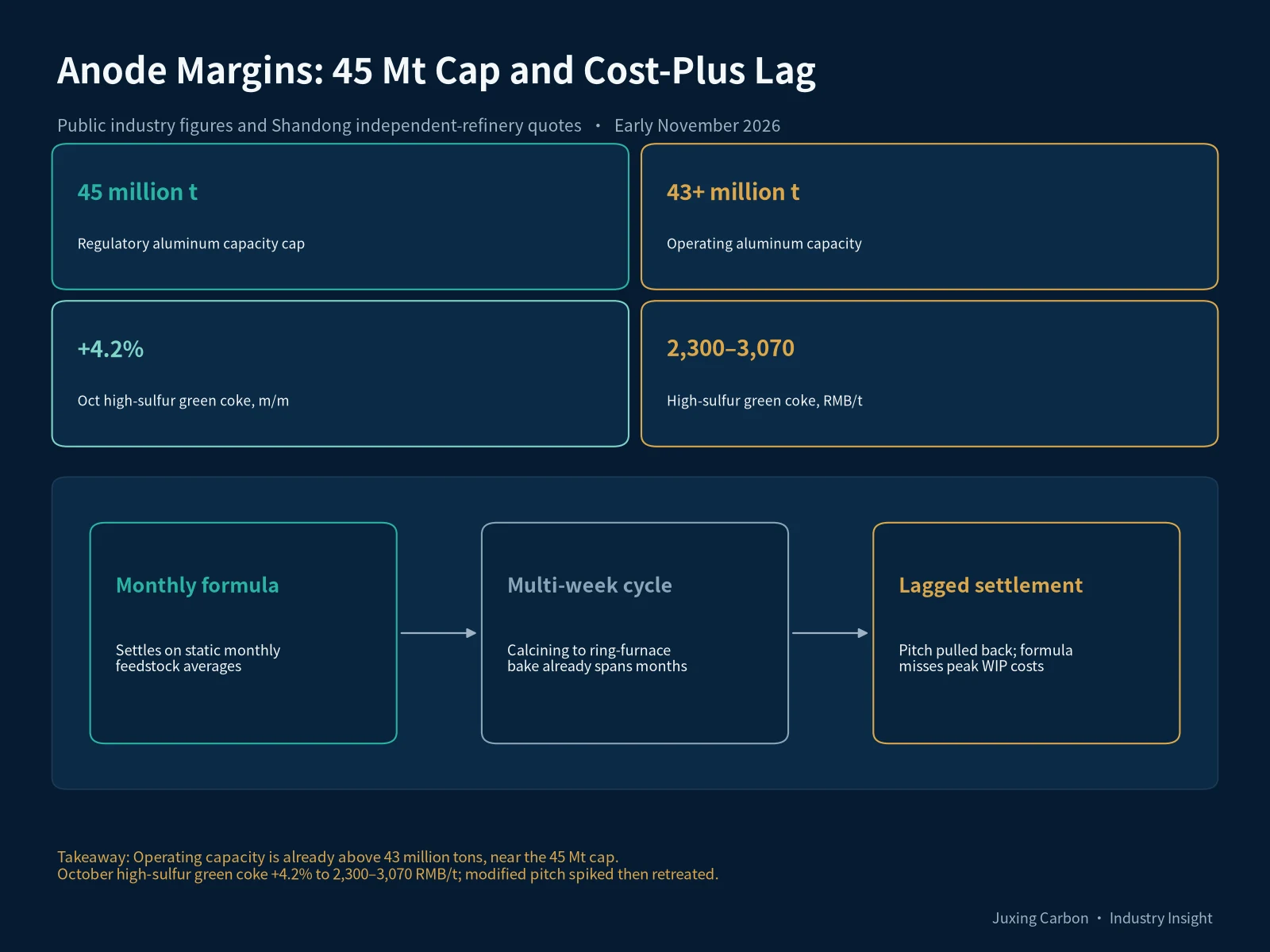
Despite high profitability across China’s 43+ million tons of operating aluminum smelting capacity, commercial prebaked anode producers remain locked into razor-thin margins due to the 45-million-ton smelting capacity ceiling and lagged monthly cost-plus pricing formulas.
A stark profitability gap currently separates primary aluminum smelters from their upstream carbon suppliers in China. While domestic aluminum operating capacity stands firmly above 43 million tons with robust per-ton smelting margins, benchmark prices for commercial prebaked anodes have moved sideways for months, leaving standalone anode producers on paper-thin margins. Two structural mechanisms prevent downstream smelting windfalls from spilling over into the commercial anode sector: the monthly cost-plus pricing formula and the hard ceiling on domestic smelting capacity.
Cost-Plus Pricing
Data basis: public industry figures and Shandong independent-refinery quotes as of early November 2026.
First, the industry’s monthly cost-plus pricing mechanism functions as a strict margin cap that suffers from cycle lag. Major aluminum groups set monthly benchmark anode prices by plugging public average prices for petroleum coke, modified coal tar pitch, natural gas, and electricity into a transparent formula, leaving suppliers only a thin, fixed conversion fee. Because prebaked anode manufacturing—spanning calcining, kneading, forming, and ring-furnace baking—takes several weeks, this static monthly formula creates severe timing mismatches. In October, for instance, Shandong high-sulfur green coke rose 4.2% month-on-month to 2,300–3,070 RMB/ton while modified pitch spiked before pulling back. Anode plants absorbed peak raw material costs inside their work-in-process inventory, yet by the time monthly settlement arrived, spot pitch prices had retreated—resulting in flat or lower formula-determined anode prices.
| Item | Public figure | What it shows |
|---|---|---|
| Formula collection window | That month’s static feedstock averages | Sets the next month’s anode price |
| Anode production cycle | Several weeks (tens of days) | WIP already spans the month-end |
| October Shandong high-sulfur green coke | About +4.2% month-on-month, at 2,300–3,070 RMB/ton | Peak feedstock costs sit inside WIP |
| Modified coal tar pitch | Spiked, then pulled back | Spot prices had retreated by settlement |
Note: Figures follow the source quotes and cycle description; the formula price often cannot cover earlier work-in-process costs.
Capacity Ceiling
Second, domestic anode demand is permanently capped while supply remains structurally long. China’s regulatory ceiling for primary aluminum capacity is locked at roughly 45 million tons. With operating capacity already above 43 million tons, domestic monthly prebaked anode consumption has virtually zero room for volume growth. Meanwhile, total commercial prebaked anode capacity across China significantly exceeds domestic smelter demand. Desperate to keep capital-intensive ring baking furnaces lit and retain long-term supply allocations, commercial anode makers have no bargaining leverage to negotiate above-formula premiums.
| Item | Public figure | What it shows |
|---|---|---|
| Primary aluminum capacity cap | Locked at roughly 45 million tons | Domestic demand is capped, with no volume upside |
| Operating aluminum capacity | Already above 43 million tons | Close to the ceiling, at historically high utilization |
| Commercial prebaked anode capacity | Structurally above actual demand | A buyer’s market; pricing power sits downstream |
| Conversion fee | A thin, fixed processing margin | Little room to pass costs up or extract a premium |
Note: The source does not state a specific commercial-anode capacity tonnage, so none is inferred here.
Procurement Implications
Nor can anode plants easily cut costs through aggressive low-grade coke blending: strict smelter specifications on trace metals, air reactivity, and CO₂ reactivity mean that any anode dusting or spalling inside the reduction cell triggers severe financial penalties. Caught between volatile feedstock costs and a rigid cost-plus formula, commercial prebaked anode producers remain structurally restricted to narrow processing margins.