

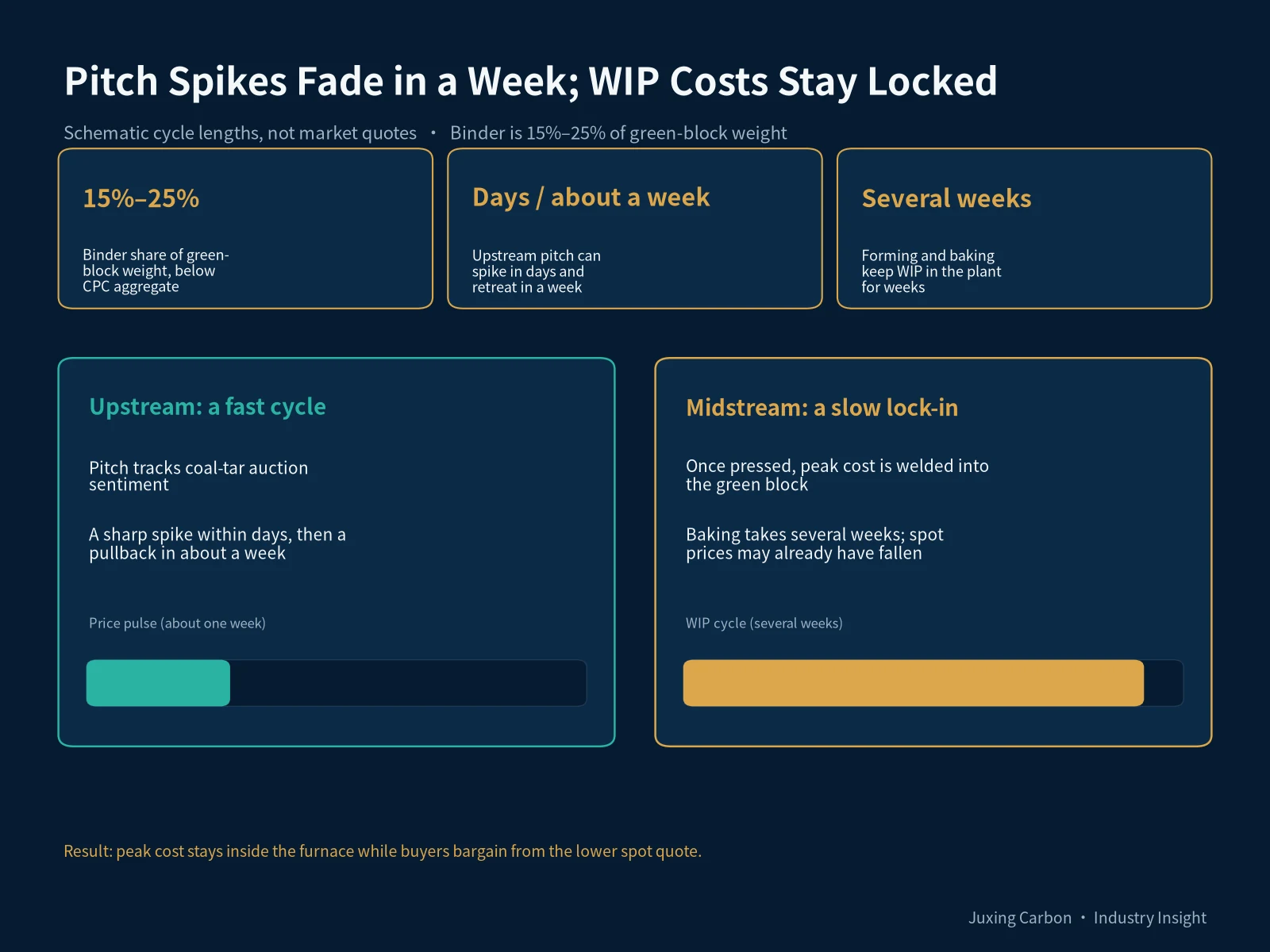
Sharp spikes and pullbacks in modified coal tar pitch prices have exposed long-cycle carbon manufacturers to severe work-in-process (WIP) cost mismatches and formulation stability challenges during kneading and baking.
In carbon product manufacturing, modified coal tar pitch serves as the essential binder, typically accounting for 15% to 25% of green block weight alongside calcined petroleum coke (CPC) aggregate. Although its mass share is smaller than that of coke aggregate, the recent rollercoaster swing in modified pitch prices—surging rapidly to a peak before pulling back—has inflicted heavy pressure on midstream carbon plants across both cost management and process stability.
Cost Mismatch
Data basis: Binder share and cycle lengths follow industry practice in carbon forming and baking, together with public observations of the recent sharp rise and pullback in modified coal tar pitch. This article does not cite specific public quotes or quote dates.
The core issue stems from a structural mismatch between fast-moving upstream coal-chemical pricing and slow-moving midstream carbon production cycles. Upstream coal tar pitch prices react immediately to coal tar auctions, capable of spiking within days and retreating within a week. By contrast, once pitch and calcined coke are kneaded into paste and pressed into green blocks, those work-in-process (WIP) blocks must undergo slow baking cycles lasting several weeks inside the furnace.
| Item | Cycle or share | Implication for carbon plants |
|---|---|---|
| Binder share of green-block weight | 15%–25% | Smaller than CPC aggregate, but enough to lock in cost |
| Upstream coal-tar pitch prices | Spike within days, retreat in about a week | Fast cycle, tied to coal-tar auctions |
| Midstream forming and baking | WIP often stays in the plant for several weeks | Slow cycle; spot prices may already have fallen at shipment |
Note: The table compares cycle lengths and formulation share only; it does not represent a public quote on any given day.
On the financial ledger, this cycle mismatch traps manufacturers in a painful margin scissors. When pitch prices spiked to peak levels, carbon plants could not simply halt their presses or leave baking furnaces empty; they had to procure peak-priced pitch and lock that cost inside their green blocks. By the time those blocks completed their multi-week baking cycle and emerged as finished products, spot pitch prices in the open market had already retreated. Facing sluggish downstream demand, buyers immediately referenced the lower current spot pitch quotes to demand finished-product discounts—preventing carbon plants from passing through costs on the way up while forcing price cuts on the way down.
Forming Risk
On the shop floor, sudden binder volatility also threatens forming and baking quality. Extrusion and molding processes are highly sensitive to the softening point, coking value, and beta-resin content of modified pitch. Even minor shifts in binder properties require recalibrating kneading temperatures and paste plasticity; otherwise, baked blocks risk internal micro-cracks or spalling. During the price spike, producers tempted to blend cheaper medium-temperature or off-spec pitch faced elevated scrap rates, whereas disciplined manufacturers that paid peak prices for premium modified pitch to protect product quality were left holding high-cost inventory once spot prices fell.
| Binder property or choice | Process requirement | Risk when it shifts |
|---|---|---|
| Softening point, coking value, beta-resin | Kneading temperature, paste plasticity and mix ratios must be re-matched | Internal micro-cracks or spalling in baked blocks |
| Blending medium-temperature or off-spec pitch | An attempt to cut procurement cost | Materially higher baking scrap rates |
| Staying with premium modified pitch | Protects product quality | Larger inventory write-down pressure after the pullback |
Note: The property names are the usual forming-process requirements for modified pitch; this article does not give numeric spec limits or purchase prices.
Procurement Implications
In a long-cycle manufacturing sector, a sharp raw material spike followed by a rapid drop does not bring immediate relief—the peak cost remains locked inside the baking furnace for weeks to come.