

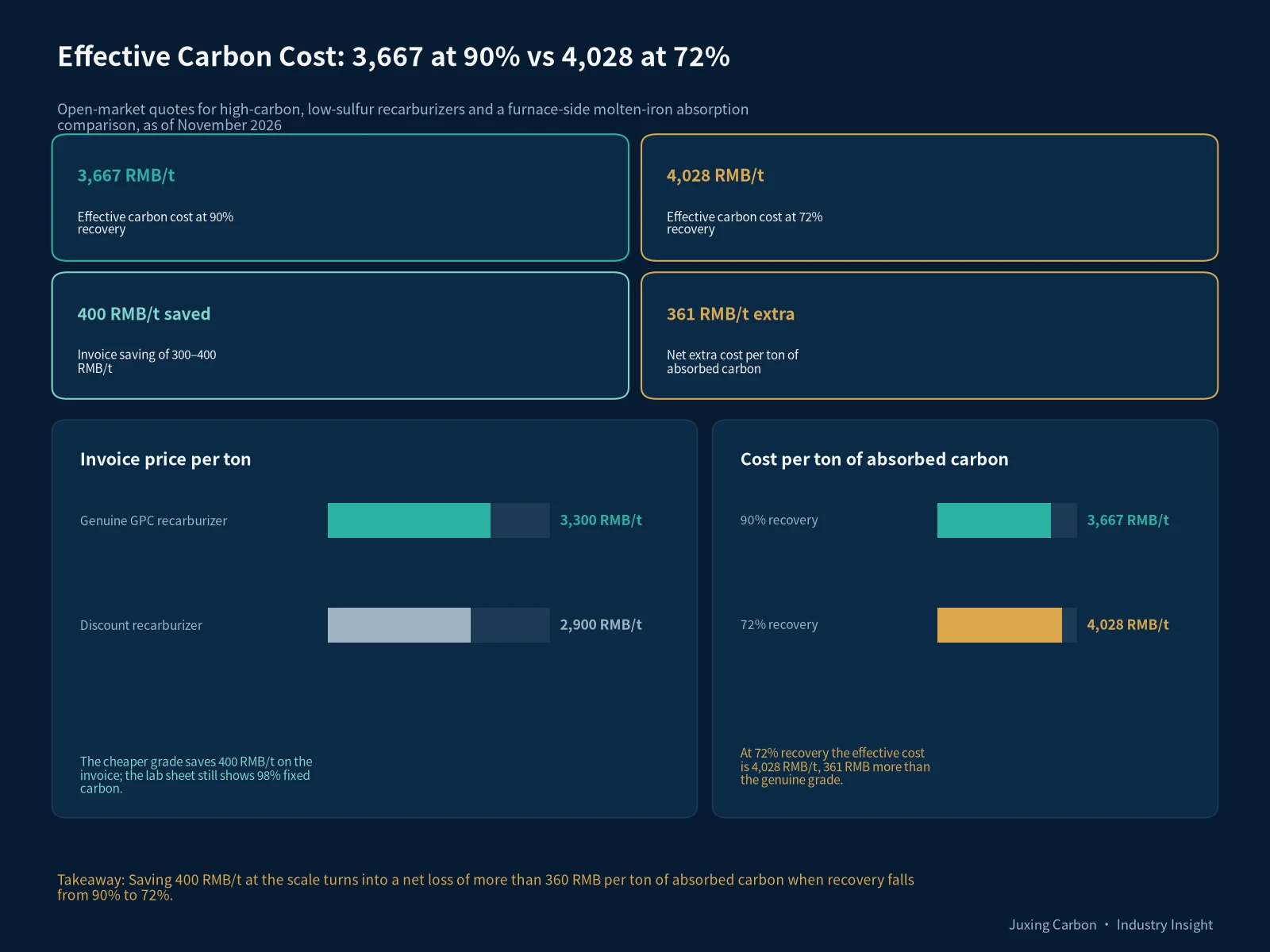
A recarburizer priced 300–400 RMB/ton lower on the invoice can increase the actual cost per ton of absorbed carbon in molten iron by over 360 RMB when semi-graphitized blending or briquetted fines cause recovery rates to drop from 90% to 72%.
In foundry and specialty steelmaking procurement, price negotiations for high-carbon, low-sulfur recarburizers frequently focus on nominal invoice price per metric ton. Yet when furnace-side molten-iron absorption (recovery) rates are factored into the equation, discounted recarburizers routinely result in higher net carbon costs and elevated melting expenses.
Effective Carbon Cost
Data basis: open-market quotes for high-carbon, low-sulfur recarburizers and a furnace-side molten-iron absorption comparison, as of November 2026.
Consider a standard furnace-side cost comparison using open-market figures. Genuine high-temperature graphitized petroleum coke (GPC) recarburizer (1–5 mm virgin granules, ≥98.5% fixed carbon) priced at 3,300 RMB/ton typically achieves a stable absorption rate of around 90% in molten iron. The actual cost per ton of effective carbon dissolved into the bath is 3,300 ÷ 90% = 3,667 RMB. By contrast, if a foundry purchases a discounted recarburizer at 2,900 RMB/ton (saving 400 RMB/ton on paper) with a lab sheet still showing 98% fixed carbon, but the actual furnace absorption rate drops to 72%, the effective cost per ton of dissolved carbon jumps to 2,900 ÷ 72% = 4,028 RMB. Saving 400 RMB/ton at the scale results in a net loss of more than 360 RMB per ton of absorbed carbon.
| Item | Genuine GPC recarburizer | Discount recarburizer |
|---|---|---|
| Invoice price | 3,300 RMB/ton | 2,900 RMB/ton |
| Lab-sheet fixed carbon | ≥98.5% | 98% |
| Particle size | 1–5 mm virgin granules | — |
| Molten-iron absorption | About 90% | 72% |
| Effective carbon cost | 3,667 RMB/ton | 4,028 RMB/ton |
| Versus the invoice | — | Save 400 RMB on paper, lose more than 360 RMB in fact |
Note: 3,300 ÷ 90% = 3,667 RMB/ton and 2,900 ÷ 72% = 4,028 RMB/ton follow the source. The 400 RMB invoice saving and a net loss of more than 360 RMB also follow the source wording; no tighter spread is inferred.
Two Cost-Cutting Practices
Two widespread cost-cutting practices explain why recarburizers with identical lab carbon numbers behave so differently in the melt:
1. Blending Semi-Graphitized Coke or Calcined Coal: Genuine graphitized recarburizer has been heat-treated near 3,000°C, aligning carbon atoms into a crystalline layered graphite lattice that dissolves rapidly upon contacting molten iron. Cut-rate alternatives either fall short of full graphitization temperatures or blend in standard calcined petroleum coke (CPC) and calcined anthracite. Standard laboratory loss-on-ignition tests measure total carbon combustion but cannot distinguish crystalline graphite from slow-dissolving amorphous carbon.
2. Briquetting and Granulating Under-Screen Fines: During crushing and screening, 1–5 mm virgin granules command a premium while under-screen dust is cheap. When producers bind fine dust into pellets and mix them into virgin granules, the pellets pass visual and lab checks at room temperature. Once charged into a 1,500°C induction furnace, however, the binder volatilizes instantly—causing the pellets to disintegrate into fine dust that is sucked straight into the dust-collection hood or left floating on the melt as viscous slag.
Hidden Furnace Costs and Implications
Beyond the direct carbon loss, a drop from 90% to 72% recovery forces operators to charge over 20% more material, extend high-power furnace holding and stirring times, accelerate refractory lining erosion, and manually skim excess slag. Evaluating recarburizers by cost per ton of absorbed carbon rather than gross invoice weight is essential for controlling true melting costs.