
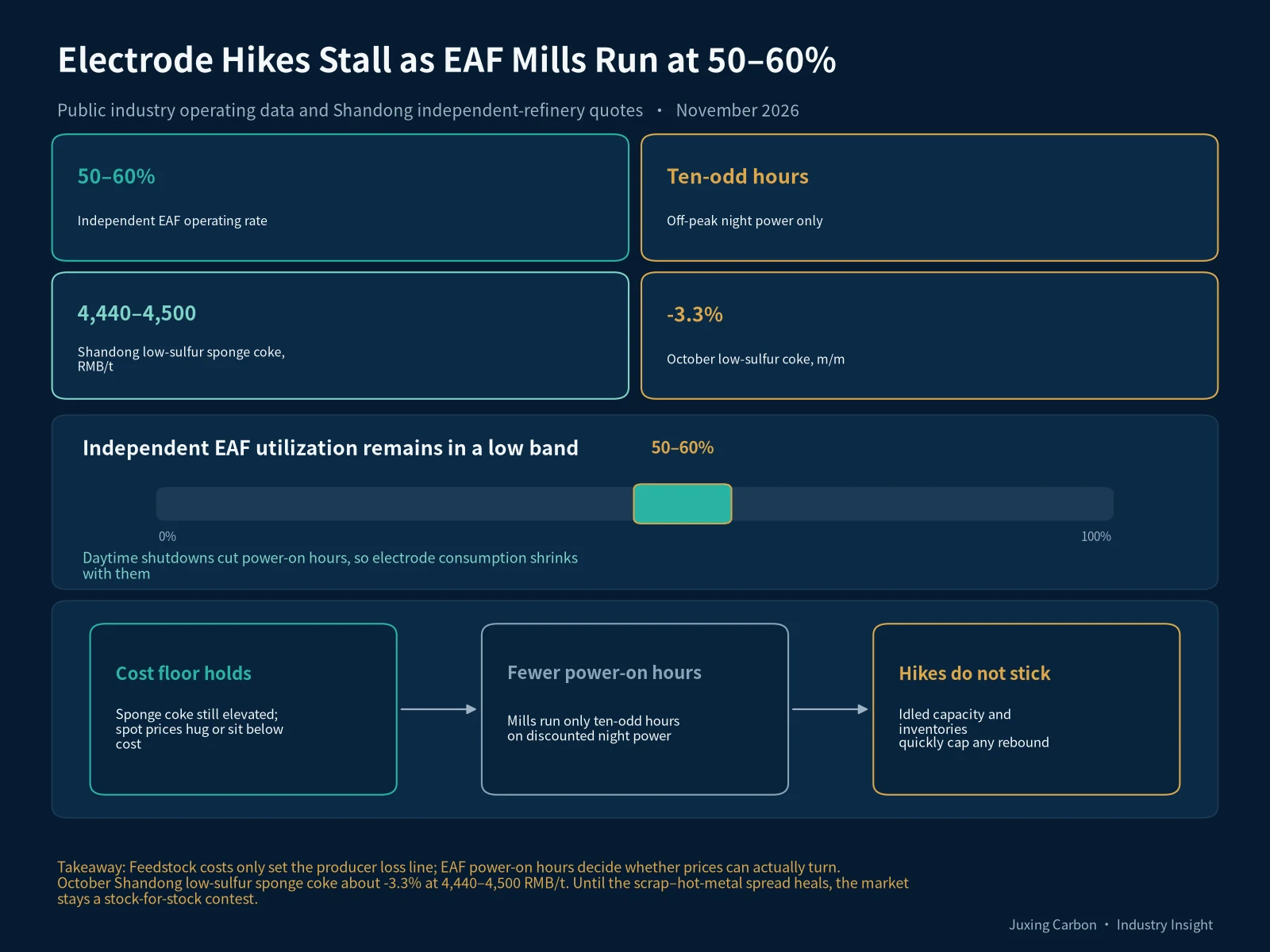
While high feedstock costs keep graphite electrode producers near breakeven, independent Electric Arc Furnace (EAF) steel mills operating at just 50%–60% capacity on off-peak night power prevent tentative electrode price hikes from sticking.
In China’s graphite electrode market, producers periodically issue tentative price-increase notices seeking to lift regular-power or high-power electrode quotes by several hundred RMB per ton. From a production-cost perspective, the push is understandable: even after a ~3.3% month-on-month dip in October, low-sulfur sponge coke in Shandong remains elevated at 4,440–4,500 RMB/ton, and combined with a two-to-three-month manufacturing cycle, current spot electrode prices are already hugging or sitting below full production cost. Yet cost support alone has repeatedly failed to translate into sustained price recovery, primarily because downstream Electric Arc Furnace (EAF) steelmaking remains under severe margin pressure.
EAF Utilization
Data basis: public industry operating data and Shandong independent-refinery quotes as of November 2026.
Graphite electrode demand is tied directly to EAF steelmaking operating rates, which across independent Chinese EAF mills have hovered between 50% and 60%. What governs EAF utilization is not the carbon supplier's cost sheet, but the "hot metal versus steel scrap spread" inside the steel industry. Because scrap steel prices remain stubbornly high and industrial electricity is a rigid cash cost, melting scrap in an EAF frequently costs more per ton of crude steel than blast-furnace hot metal—leaving EAF flat-power margins below breakeven.
| Item | Public figure | What it shows |
|---|---|---|
| Independent EAF operating rate | Has hovered between 50% and 60% | End-use load stays low |
| Daytime operations | Furnaces shut on peak power | Idle during flat-power hours |
| Night off-peak power | Only ten-odd hours of discounted operation | Power-on hours shrink sharply |
| How electrodes are consumed | Arc oxidation during power-on hours | Less power-on time, less consumption |
Note: Figures follow the source operating-rate band and off-peak running pattern; graphite electrodes are consumed by arc oxidation only while the furnace is powered on.
Cost Support vs Demand
To minimize losses, most independent EAF mills shut down during daytime peak electricity hours and operate only ten-odd hours per day on discounted off-peak night power. Because graphite electrodes are consumed through arc oxidation and sublimation strictly during power-on hours, every hour a furnace sits idle directly reduces physical electrode consumption. When upstream electrode plants attempt to pass through higher feedstock costs, cash-strapped steel mills simply defer purchases, extend maintenance shutdowns, or downgrade electrode specifications.
| Item | Public figure | What it shows |
|---|---|---|
| October Shandong low-sulfur sponge coke | About -3.3% month-on-month, at 4,440–4,500 RMB/ton | Absolute prices remain elevated |
| Electrode production cycle | Two to three months | Costs are already locked in WIP |
| Spot electrode prices | Hugging or sitting below full production cost | The cost floor only sets the loss line |
| EAF flat-power margins | Below breakeven | Mills lack room to accept hikes |
| Any few-hundred RMB/ton rebound | Idled capacity and inventories re-enter | The bounce is quickly capped |
Note: The source does not state EAF steel output, electrode capacity tonnage, or mill profit amounts, so none are inferred here.
Procurement Implications
On the supply side, substantial legacy capacity and inventory overhang remain ready to re-enter the market. Whenever specific electrode grades manage to open a few hundred RMB/ton of margin, idled furnaces and stockpiles quickly return, capping the rebound. Ultimately, raw material cost floors only dictate producer losses; a genuine price recovery in graphite electrodes requires a reversal in EAF steelmaking margins and power-on operating hours.