




【Graphite Anode】Milling Process!

The rapid growth of the EV and energy storage industries is boosting demand for high-performance lithium batteries, driving the market for quality petroleum coke and synthetic graphite. The quality and particle size of calcined petroleum coke directly affect synthetic graphite performance, especially in anode production.
【Graphite Anode】Milling Process!
In the production process of artificial graphite anode materials, almost all process routes require crushing at the very front end. As the first process step, milling plays a crucial role.
Milling equipment is mainly divided into roller press mills, mechanical mills, and jet mills. Jet mills are mainly used for pitch crushing, roller press mills are mainly used for calcined coke production lines, and mechanical mills are mainly used for green coke production lines.
Milling Process Flow
(1) Roller Press Mill Process Flow:
Feeding – Hammer Crusher (Coarse Crushing) – Roller Press Mill (Milling) – Shaping (Spheronization) – Classification
(2) Mechanical Mill Process Flow:
Feeding – Hammer Crusher (Coarse Crushing) – Rotary Kiln (Drying) – Mechanical Mill (Milling) – Shaping (Spheronization) – Classification
Hammer Crusher (Coarse Crushing)
(1) Purpose:
To crush large raw materials to around 10 mm, facilitating subsequent processing stages (drying/fine milling) and improving production efficiency.
(2) Principle:
High-speed rotating hammer heads collide with the material. The hammers strike the material, materials collide with each other, and materials impact the liner plates, breaking the material. When the particle size meets the requirement, it is discharged through the grate bars. If the required size is not reached, the material is lifted by the hammers and repeatedly impacted.
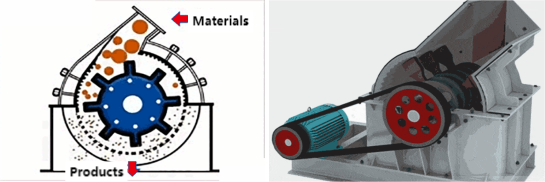
Hammer Crusher Structural Diagram
Roller Press Mill (Milling)
(1) Purpose:
To ultrafine grind calcined petroleum coke with relatively high hardness after coarse crushing, achieving micron-level particle size control.
(2) Principle:
The roller press mill is an internal classification high-pressure ultrafine roller grinding mill that can simultaneously complete fine grinding and fine powder classification. The main shaft rotation drives the wheel frame to rotate, which in turn drives the auxiliary shafts. The grinding wheels on the auxiliary shafts not only revolve around the main shaft but also rotate around their own axes. During revolution and rotation, the grinding wheels generate strong centrifugal force and intensely grind against the grinding ring. The coarsely crushed material enters the grinding zone formed by the grinding wheels and the grinding ring, where it is crushed under strong extrusion and grinding forces.
The crushed material falls onto the throwing disc, which rotates synchronously with the main shaft and throws the powder toward the annular space between the grinding ring and the casing. Under system negative pressure, the powder rises through the gap into the upper classification chamber for classification. Qualified fine powder passes through the classification wheel into the collection system, while coarse material falls along the inner wall back into the grinding chamber for regrinding.
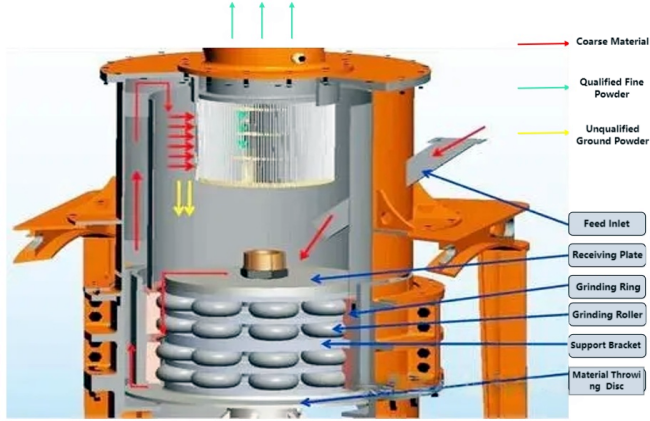
Internal Structure Diagram of Roller Press Mill
Mechanical Mill (Milling)
(1) Principle:
Material located in the gap between the stator and rotor is sheared and rebounded into the crushing chamber, colliding with subsequently high-speed moving particles, resulting in repeated crushing. A strong high-speed turbulent field is formed between the stator toothed ring and the impact hammer heads at the rotor end, generating strong pressure fluctuations. The material is crushed under alternating stress.
(2) Purpose:
To ultrafine grind the coarsely crushed material and achieve micron-level particle size control.
(3) Main Mechanism:
The energy generated by multiple impacts exceeds the energy required for material crushing, causing the particles to be crushed.
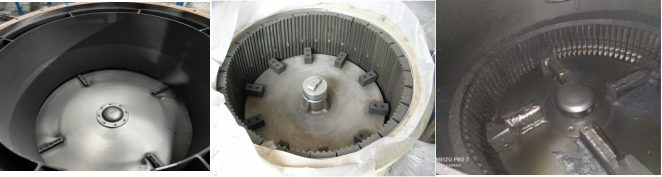
Internal Structure Diagram of Mechanical Mill
Shaping Machine (Spheronization)
Purpose:
To spheronize the material, smooth sharp edges, make the particle morphology more regular, and improve tap density.
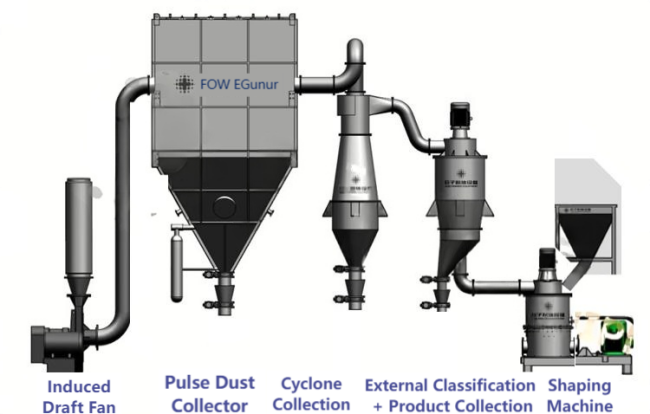
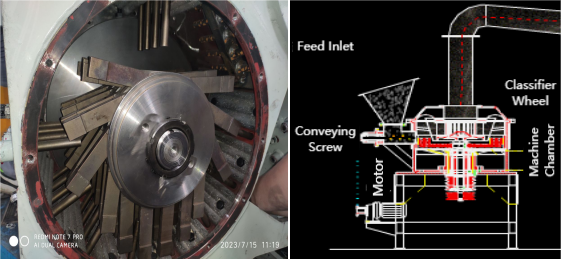
Shaping Machine Structural Diagram
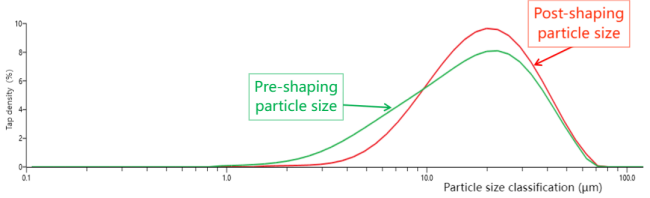
Comparison of Particle Size Volume Distribution Before and After Shaping
Classifier Wheel (Classification and Screening)
The powder to be classified enters the classification chamber from bottom to top carried by airflow. During the rising process, the powder is subjected to the "air screening" effect of secondary air, separating fine particles mixed in the coarse powder, allowing fine powder to continue rising with the airflow.
At the bottom of the impeller, due to high-speed rotation, the rising powder is dispersed and evenly distributed to move in all directions. When the powder reaches the impeller classification zone, a strong centrifugal force field is generated by the high-speed rotation of the impeller. At this time, the powder is subjected to both the upward airflow and the centripetal force generated by the exhaust fan behind the classifier, as well as the centrifugal force generated by the impeller rotation.
Coarse particles, for which centrifugal force is greater than centripetal force, are thrown toward the cylinder wall and move downward along the wall into the impact fine grinding system. Fine particles, for which centripetal force is greater than centrifugal force, pass through the impeller gaps with the airflow, are discharged through the fine particle outlet, and are collected by the downstream collection system.
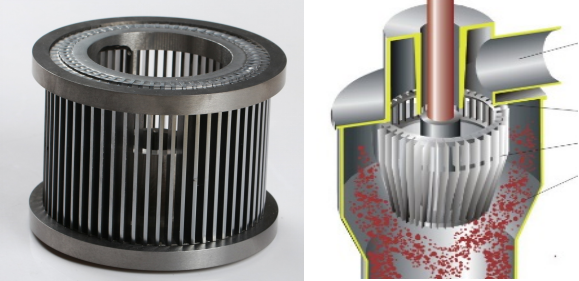
Classifier Wheel Structural Diagram
Feel free to contact us anytime for more information about the Anode Material market. Our team is dedicated to providing you with in-depth insights and customized assistance based on your needs. Whether you have questions about product specifications, market trends, or pricing, we are here to help.
No related results found




0 Replies