




【Overseas】Persian Gulf Paralysis? The Impact of the U.S.–Iran War on Global Steel Trade

Graphite electrodes are the "lifeline" of EAF steelmaking! As the core material for arc conduction and heating, they feature high conductivity and heat resistance, directly affecting molten steel quality and output. Mastering graphite electrodes means mastering the initiative in EAF steelmaking!
【Overseas】Persian Gulf Paralysis? The Impact of the U.S.–Iran War on Global Steel Trade
On February 28, 2026 (local time), the conflict between the United States and Iran escalated into a full-scale confrontation, sharply intensifying geopolitical tensions in the Middle East. As a crucial chokepoint for global energy and bulk commodity shipping, disruptions to navigation in the Strait of Hormuz and tightening shipping routes have directly shaken global supply chains. This strategic waterway is not only the lifeline of oil transportation but also a critical corridor for global steel import and export trade. Once navigation becomes restricted, the international steel trade landscape could face comprehensive disruption. Amid the outbreak of war, what kind of turbulence and restructuring will global steel trade encounter?
Short-Term View: The U.S.–Iran War Raises the Risk of Steel Trade Stagnation in the Persian Gulf, Pressuring China's Steel Exports
Multiple disruptions along Gulf shipping routes, exporters facing major order delays
According to investigations, the current Middle East situation has already disrupted several ports in the Gulf region. Bahrain has suspended port operations, including pilotage services; Jebel Ali Port has fully halted operations after a fire triggered by intercepted airstrike debris; Qatar's Ras Laffan and Mesaieed ports remain operational but with reduced traffic, affected by GPS signal interference and government airspace closures. Similarly, Chinese exporters are facing significant disruptions in both new orders and shipments.
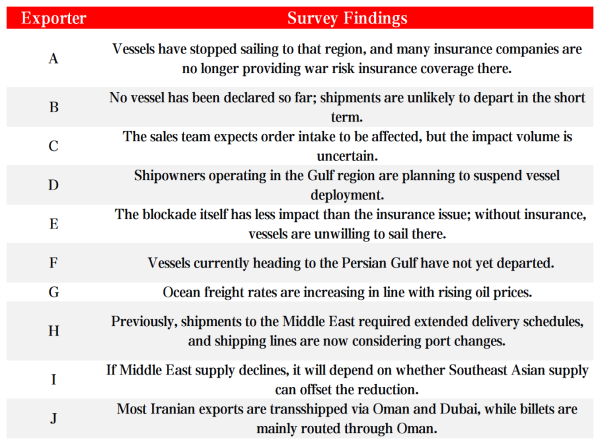
Data source: SMM
Estimated Impact on Core Ports Within the Strait of Hormuz
If a physical blockade occurs in the Strait of Hormuz—this critical chokepoint—the five key inner-gulf ports most directly affected, where logistics could "come to an instant halt," would be Bandar Abbas Port, Bandar Imam Khomeini Port, Jebel Ali Port, Khalifa Port, and King Abdullah Port. Meanwhile, a blockade of the Strait could place around 10% of global seaborne steel trade (mainly semi-finished products and specialty ores) at risk of disruption. In addition, Direct Reduced Iron (DRI) produced by Iran holds an important position in global supply. Any supply interruption could significantly increase the production costs of electric-arc-furnace steelmaking in the Middle East.
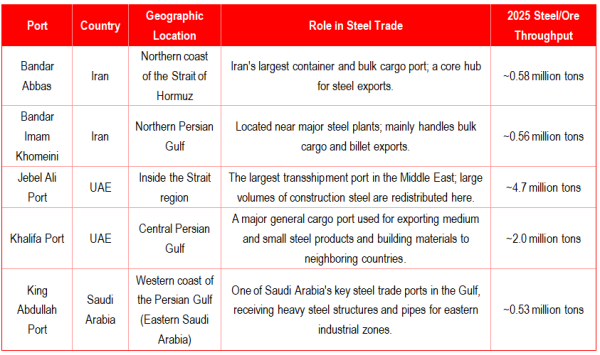
Data source: SMM Ferrous Panorama Shipping
After a Blockade, Will Cargo Transportation Completely Stop?
Seaborne transportation routes would indeed largely come to a halt, but cargo flows would not disappear entirely. Instead, logistics would become extremely expensive, slower, and dependent on complex land transshipment routes. For example, strategic alternative ports outside the strait include Sohar Port, Chabahar Port, and Gwadar Port.
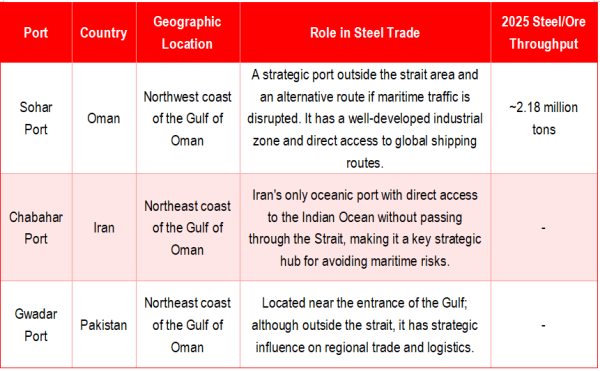
Data source: SMM, compiled based on publicly available information
Trade Suffocation Triggered by the Withdrawal of Insurance Coverage
Another issue as severe as a maritime blockade is the availability of war-risk insurance. Marine insurance institutions Skuld and Gard have already stated that due to the escalating tensions in the Middle East, they will cancel war-risk insurance coverage. Feedback from the UAE also indicates that many insurers do not provide war-risk coverage for the Red Sea region. This means traders must bear multiple uncontrollable risks and assume responsibility themselves, which will have a massive impact on the ability to secure new orders.
Summary: The "Hedging" Impact of the Strait of Hormuz Crisis on China's Steel Market – Short-Term Pressure on Exports
Short-term bearish factors (demand and logistics suppression):
The sudden halt of Gulf shipping routes will cause China's steel exports to Middle Eastern countries such as Saudi Arabia and the UAE to experience a "cliff-like decline." In some cases, export disruptions may redirect resources back into the domestic market, increasing domestic supply pressure and exerting downward pressure on steel prices.
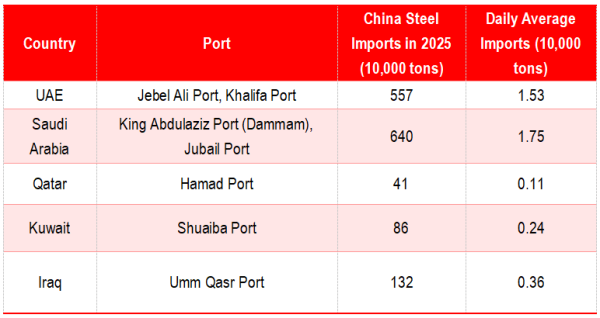
Data source: SMM, General Administration of Customs of China
Medium-Term View: Iran as a Major Steel Supplier – Export Disruptions May Trigger Billet Shortages in Southeast and South Asia
From Construction to Industry: Iran's Steel Export Structure Transformation and the Peak Era of Billet Dominance
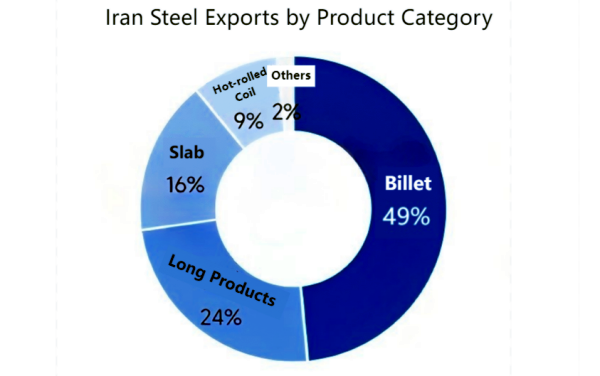
According to data released by the Iranian Steel Producers Association (ISPA), 2025 marked the "peak moment" of Iran's steel exports, with a highly aggressive export structure:
① Absolute dominance of semi-finished products:
From March to December 2025, Iran's billet exports reached 4.58 million tons (YoY +37.7%), while slab exports totaled 1.54 million tons (YoY +44.6%). This confirms the earlier point that a blockade of the Strait could lead to clear "billet panic" among downstream steel mills in Southeast Asia and the Middle East.
② Structural leap in flat steel products:
Exports of finished flat products surged from 307,000 tons in the previous year to 1.03 million tons. In particular, the expansion of hot-rolled coil exports (867,000 tons) and coated steel products (YoY +76.7%) indicates that Iran has begun transitioning from a "construction steel supplier" to a "supplier of industrial raw materials."
③ Weakness and contraction in long products:
In contrast, exports of finished long products (rebar and wire rod) declined 9.9%, while section steel exports plunged 27.7%. This trend of "reducing long products while increasing flat products" may further intensify inventory pressure on finished goods under the current backdrop of stalled infrastructure projects.
Data source: Iranian Steel Producers Association (ISPA)
Medium-Term Bullish Factors: Cost Support and Substitution Effects
Iran's nearly 11 million tons of steel export shortfall could trigger regional supply shortages, forcing some buyers in Southeast Asia and South Asia to turn to China for procurement, thereby generating "substitution-driven demand growth." At the same time, rising crude oil prices may push up costs across the entire industrial chain, providing bottom support for steel prices.
Although logistics disruptions and project suspensions may suppress export performance in the short term, the reshuffling of the global supply landscape may partially offset these negative effects. Chinese steel products could potentially play a key role in filling global supply gaps.
Long-Term Perspective: A Potential Ceasefire in Iran May Temporarily Shock the Global Steel Market
The "Stockpiling Effect" Under Blockade: Rapidly Rising Inventory Pressure at Iranian Mills and Ports
According to the latest global steel statistics report released by the World Steel Association (WSA), Iran's crude steel production reached 31.8 million tons in 2025, up 1.4% year-on-year from 2024, maintaining its position as the 10th largest steel-producing country in the world. In December 2025, Iran produced 3 million tons of crude steel in a single month, representing a sharp 16.2% year-on-year increase. This indicates that Iranian steel mills were in the midst of a peak production phase just before the conflict erupted.
In January 2026, Iran's crude steel output was approximately 2.6 million tons, a 15.1% year-on-year increase. While global crude steel production in January declined 6.5% year-on-year, Iran was experiencing an "independent growth trend."
According to SMM research, the inertia from previously high production levels has resulted in extremely severe inventory accumulation at domestic steel mills. The logistics blockade that began in late February has prevented steel products produced during this high-output period from being fully shipped out of the Persian Gulf. As a result, ports and mills are currently holding large volumes of slabs and billets originally intended for export.
Once the situation eases, this batch of "low-cost inventory" could flood the market at discounted prices, potentially impacting global markets. However, considering the likelihood of post-war reconstruction demand in Iran, the actual release of these supplies into the market will require continuous monitoring.
Feel free to contact us anytime for more information about the EAF Steel market. Our team is dedicated to providing you with in-depth insights and customized assistance based on your needs. Whether you have questions about product specifications, market trends, or pricing, we are here to help.
No related results found




0 Replies