




【Steel】Global Crude Steel Capacity Recovery: China's Steel Exports Facing ...

Graphite electrodes are the "lifeline" of EAF steelmaking! As the core material for arc conduction and heating, they feature high conductivity and heat resistance, directly affecting molten steel quality and output. Mastering graphite electrodes means mastering the initiative in EAF steelmaking!
【Steel】Global Crude Steel Capacity Recovery: China's Steel Exports Facing "Pressure from Both Front and Back"
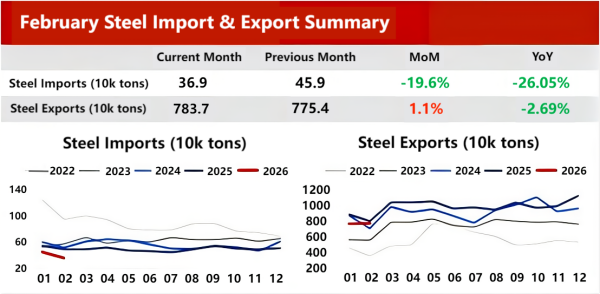
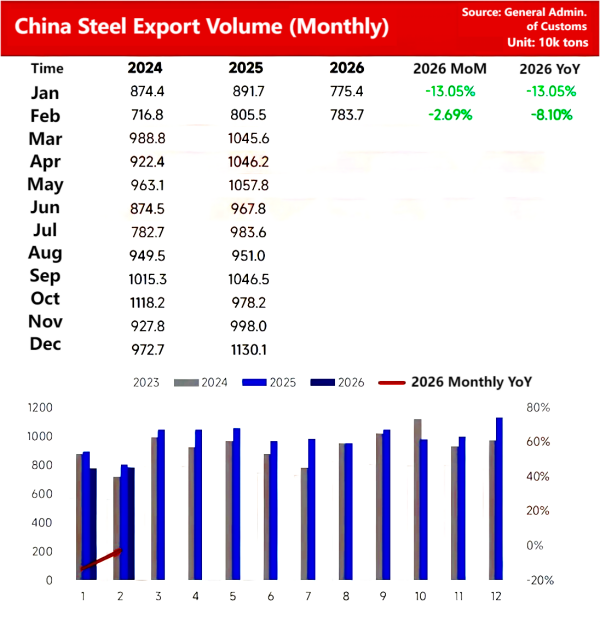
On March 10, data from the General Administration of Customs showed that China exported 15.591 million tons of steel cumulatively in January–February 2026, a year-on-year decline of 8.1%, with steel exports reaching 7.837 million tons in February.
In January–February 2026, China's cumulative steel imports totaled 827,000 tons, down 21.7% year-on-year.
Source: SMM
1. China's Steel Exports Declined Year-on-Year in February
Against the backdrop of a high base last year, China's cumulative steel exports in January–February fell 8.1% year-on-year, but the level still remained relatively high compared with the same period in previous years.
The year-on-year decline in cumulative exports during January–February was partly due to policy impacts. At the end of 2025, the Ministry of Commerce announced that export licenses would be implemented from January 1, 2026. As the policy basically covers all categories of steel exports, the uncertainty surrounding the policy caused some export traders to become more cautious in taking orders.
On the other hand, the appreciation of the RMB weakened China's export price advantage, which also affected order intake to some extent.
Although February had fewer days, the month-on-month data still increased. The reason is that some steel mills engaged in formal export channels actively approached export orders to ease domestic sales pressure while traders were taking a wait-and-see stance. At the same time, in the early stage of export license implementation, both customs authorities and exporters needed to spend more time adapting to policy changes. As time passed, overall operational efficiency improved, and port clearance speed increased accordingly.
Source: SMM
China's Steel Imports Remained at a Low Level in January–February
On the import side, China imported 827,000 tons of steel in total during January–February, a year-on-year decline of 21.7%. Meanwhile, net steel exports reached 14.764 million tons, down 7.3% year-on-year.
Short-Term Outlook for Steel Exports
According to the China Federation of Logistics and Purchasing, the global manufacturing PMI was 51.2% in February 2026, up 0.2 percentage points from the previous month. It has remained above 50 for two consecutive months. Month-on-month increases were recorded in Asia, Europe, and the Americas, all staying above the threshold level, indicating signs of improvement in the global manufacturing recovery.
However, due to the impact of the Chinese Spring Festival holiday, China's manufacturing new export orders index stood at 45% in February, down 2.8 percentage points from the previous month, according to China's Manufacturing PMI data. Meanwhile, the recent sharp escalation of geopolitical risks in the Middle East has introduced uncertainties to the just-emerging recovery of the global economy.
According to monitoring data from the World Steel Association, global crude steel production reached 147.3 million tons in January 2026, a year-on-year decline of 6.5%. This was mainly dragged down by the significant contraction in China's production (falling to 75.3 million tons in a single month, down 13.9% year-on-year).
However, excluding China, other regions of the world actually achieved around 3.6% growth in January, demonstrating localized resilience amid a diverging global pattern. The continued recovery of global crude steel capacity has brought certain restraining effects on China's steel exports.
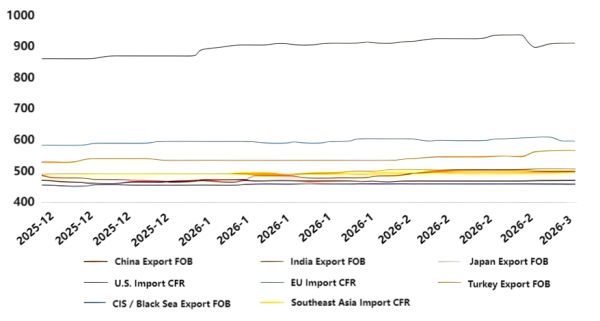
As of March 6, 2026, export quotations (FOB) for hot-rolled coils from India, Turkey, and the CIS/Black Sea region were USD 500/ton, USD 566/ton, and USD 460/ton, respectively. China's hot-rolled coil export quotation (FOB) stood at USD 472/ton. Compared with other countries, China's export price was USD -28/ton, -94/ton, and +12/ton, respectively. Overall, China's steel exports still maintain an absolute price advantage.
Figure 1: Export Quotations of Hot-Rolled Coil in Major Global Markets
Source: SMM
According to the latest export scheduling data from steel mills, the planned export volume of hot-rolled coils this month is 819,000 tons, down 125,000 tons from the actual exports of last month, representing a month-on-month decline of 13.2%. The main reason is that some large northern steel mills are adjusting their export product structure.
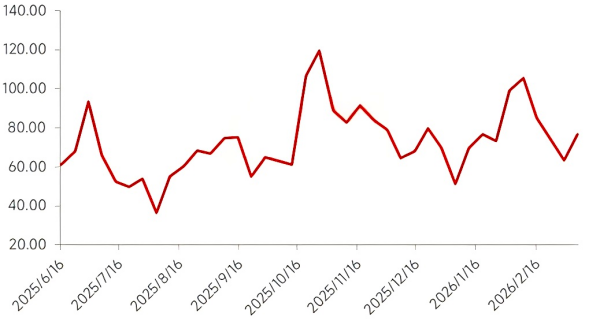
According to steel export order data, as the impact of export licenses gradually fades, export order intake began to recover gradually in mid-to-late January. At the same time, as the Spring Festival holiday approached, most export traders brought forward their sales schedules, resulting in a relatively high month-on-month growth rate in overall export orders.
However, due to the escalation of the U.S.–Iran conflict, maritime transportation has been disrupted, and earlier orders may face certain difficulties in shipment.
Taking all factors into consideration, with more days in March, SMM expects that overall export volumes may show a moderate month-on-month rebound, although product differentiation will remain evident.
Future changes in export volumes may largely depend on the development of the U.S.–Iran conflict. If the conflict ends relatively quickly, the overall impact will be limited. In fact, some domestic export traders have recently taken over semi-finished product orders originally destined for the Middle East due to the conflict. Meanwhile, Middle Eastern demand has only been postponed rather than disappeared, and there may be a surge in demand once the conflict ends.
However, if the conflict turns into a prolonged war, previously expected Middle Eastern demand may face the risk of reassessment. Uncertainties such as freight rate fluctuations may also cause some demand to shift to a wait-and-see stance.
Figure 2: Steel Export Order Volumes
Source: SMM
Feel free to contact us anytime for more information about the EAF Steel market. Our team is dedicated to providing you with in-depth insights and customized assistance based on your needs. Whether you have questions about product specifications, market trends, or pricing, we are here to help.
No related results found




0 Replies