




【Expert Insights】Principles and Process of Petroleum Coke Calcination

Calcined petroleum coke, with its high carbon content, low sulfur, and low impurities, plays a vital role in modern manufacturing, especially in the aluminum and steel industries.
【Expert Insights】Principles and Process of Petroleum Coke Calcination
I. Purpose and Significance of Calcination
Petroleum coke is a by-product obtained after crude oil is distilled to separate light and heavy fractions, and the remaining heavy oil undergoes a coking process. Raw Petroleum Coke contains a large amount of volatile matter (8–15%), moisture, and impurities. Its crystal structure is underdeveloped, and its physicochemical properties are unstable, making it unsuitable for direct use.
Calcination is a thermal treatment process carried out at high temperatures in an oxygen-deficient environment, during which raw petroleum coke undergoes a series of physical and chemical transformations. The main purposes are as follows:
1. Removal of volatile matter and moisture: Completely eliminate residual light hydrocarbons and moisture in petroleum coke.
2. Increase carbon purity: After volatile removal, carbon content rises from 80–85% to above 98–99.5%.
3. Improve true density and mechanical strength: Crystal structure shrinks and densifies, increasing true density from 1.4–1.6 g/cm³ to 2.0–2.1 g/cm³, making it stronger and more wear-resistant.
4. Enhance electrical and thermal conductivity: At high temperatures, the crystal structure develops and becomes more ordered, increasing graphite microcrystal size and significantly improving conductivity.
5. Stabilize chemical properties: After high-temperature treatment, chemical reactivity decreases, enhancing oxidation resistance and corrosion resistance in downstream applications (such as aluminum electrolysis).
Calcined Petroleum Coke (CPC) is a core raw material for producing prebaked anodes for aluminum, graphite electrodes, recarburizers, and other carbon products.
II. Basic Principles of Calcination
Calcination is essentially a complex high-temperature pyrolysis process. At temperatures of 1250–1380°C, raw petroleum coke undergoes the following transformations:
Physical Changes:
1. Dehydration: Removal of surface and bound water.
2. Release of volatile matter: Volatile hydrocarbons decompose and escape as gases, leaving pores.
3. Volume shrinkage: The release of volatiles and molecular rearrangement lead to significant volume reduction.
4. Density increase: Shrinkage results in denser particles and higher true density.
Chemical Changes:
1. Thermal decomposition reactions: Large hydrocarbon molecules (CₙHₘ) crack and polymerize, producing small gas molecules (such as H₂, CH₄, CO) and fixed carbon.
CₙHₘ → nC + (m/2)H₂ (simplified expression)
2. Crystal structure transformation (most critical): The carbon microcrystalline structure in raw coke is disordered (“turbostratic structure”). At high temperatures, carbon atoms gain energy and rearrange into a more ordered “graphitic lattice” structure. The increase in microcrystal size (Lc value) is the fundamental reason for improved conductivity and thermal properties of calcined coke.
III. Main Types of Calcination Furnaces and Their Processes
In industry, four main types of petroleum coke calciners are used: Rotary Kiln, Shaft Calciner (Vertical Calciner), Rotary Hearth Furnace (RHF), and Electric Calciner. Among them, rotary kilns and shaft calciners are the most widely used.
1. Rotary Kiln
This is currently the most widely used calcination equipment worldwide, featuring large production capacity and high automation.
Structure:
A long, slightly inclined (2–5% slope) steel cylinder lined with refractory materials.
It rotates slowly, supported by rollers and driven by gears.
The feed system and burner are located at the higher end (kiln head), while the discharge and flue gas treatment systems are at the lower end (kiln tail).
Process Flow:
1. Feeding: Crushed raw petroleum coke (typically <50 mm) is continuously fed from the kiln head.
2. Preheating zone (~600°C): The material moves slowly toward the kiln tail, heated by counter-current hot flue gas, removing moisture and some volatiles.
3. Calcination zone (1250–1380°C): Located in the middle-rear section of the kiln, where burners inject fuel (usually volatile gases from calcination) for high-temperature treatment.
4. Cooling zone: Hot calcined coke is discharged and enters a cooler (rotary drum or vertical steel tank type), where it is cooled to below 100°C.
5. Flue gas treatment: High-temperature flue gas (up to 900°C) passes through a waste heat boiler (for power generation), electrostatic precipitator (dust removal), and desulfurization/denitrification systems before discharge.
Characteristics:
1. Advantages: Continuous operation, large capacity (up to 400,000 t/year per kiln), high automation, flexible operation.
2. Disadvantages: Slightly uneven temperature distribution, higher breakage rate (fines generation), and significant refractory wear.
2. Shaft Calciner (Vertical Calciner)
A traditional intermittent/semi-continuous furnace type, known for high product quality, especially suitable for premium needle coke.
Structure:
Composed of multiple vertical calcining shafts (typically 4–8), made of silica bricks and surrounded by flue channels.
Burners in layered flues provide heat.
Process Flow:
1. Charging: Raw coke is periodically fed from the top hopper.
2. Calcination: Heat is transferred through furnace walls via radiation and conduction. Material moves downward through preheating, calcination, and cooling zones.
3. Discharge: Calcined coke is discharged continuously or intermittently from the bottom after cooling.
4. Volatile utilization: Released volatiles are reused as fuel in flue channels, improving energy efficiency.
Characteristics:
1. Advantages: Uniform temperature, high and stable product quality, high true density, low burn loss, high thermal efficiency.
2. Disadvantages: Intermittent operation, relatively smaller capacity, higher investment, lower automation, and higher labor intensity.
3. Rotary Hearth Furnace (RHF)
1. Principle: Raw coke is spread on a rotating hearth and heated by burners above. The material completes preheating, calcination, and cooling during one full rotation.
2. Characteristics: Minimal particle breakage, precise temperature control, high quality. However, high capital and operating costs limit its application.
4. Electric Calciner
1. Principle: Uses the electrical resistance of the material itself to generate heat (Joule heating, I²R), achieving very high temperatures.
2. Characteristics: Extremely high temperature (above 2000°C), clean environment (no flue gas), excellent product quality, but very high energy consumption.
IV. Key Process Control Parameters
Regardless of furnace type, the core control parameters are similar:
1. Calcination temperature: The most critical parameter. Too low leads to incomplete volatile removal; too high increases energy consumption and may cause over-graphitization or burn-off. Typically controlled at 1300 ± 50°C.
2. Residence time: Ensures sufficient time in the high-temperature zone for complete pyrolysis and structural transformation. Controlled by rotation speed (rotary kiln) or discharge rate (shaft calciner).
3. Excess air coefficient: Controls combustion air supply to ensure complete combustion while avoiding excessive cold air intake.
4. System negative pressure: Maintains slight negative pressure to prevent gas leakage and ensure an oxygen-deficient environment.
Summary
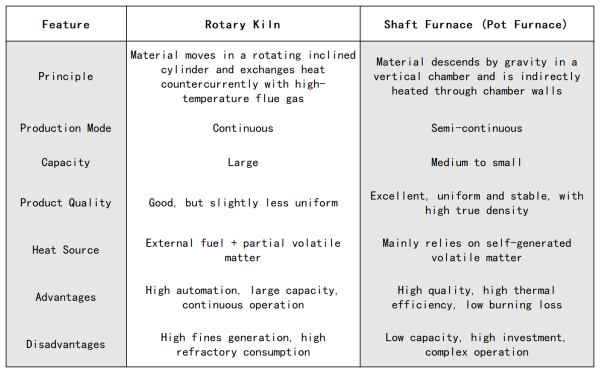
Petroleum coke calcination is a key process that converts low-value by-products into high-performance carbon materials. The choice of furnace type depends on product quality requirements, investment cost, production scale, and environmental considerations.
Currently, large-scale projects tend to adopt high-efficiency rotary kilns, while applications requiring ultra-high quality (such as ultra-high power graphite electrodes) prefer shaft calciners or electric calciners.
Feel free to contact us anytime for more information about the petroleum coke market. Our team is dedicated to providing you with in-depth insights and customized assistance based on your needs. Whether you have questions about product specifications, market trends, or pricing, we are here to help.
No related results found




0 Replies