




【Petroleum Coke】Up to +15.33%! Prices rose broadly in March, with active ...

Calcined petroleum coke, with its high carbon content, low sulfur, and low impurities, plays a vital role in modern manufacturing, especially in the aluminum and steel industries.
【Petroleum Coke】Up to +15.33%! Prices rose broadly in March, with active shipments and sales
In March, petroleum coke prices mainly increased. Domestic maintenance-related losses rose, some refineries adjusted output, and overall monthly production increased.
Domestic petroleum coke prices increased: 1# rose from RMB 4,430/t to RMB 4,682/t; medium-sulfur 3# rose from RMB 3,202/t to RMB 3,693/t; high-sulfur 4# rose from RMB 2,049/t to RMB 2,271/t; energy storage coke rose from RMB 4,185/t to RMB 4,516/t; power coke rose from RMB 4,673/t to RMB 4,985/t; anode grade 1 rose from RMB 3,448/t to RMB 3,762/t.
Ⅰ. Domestic refinery output increased; petroleum coke prices mainly rose
Table 1: Comparison of average prices of various petroleum coke grades (Unit: RMB/t)
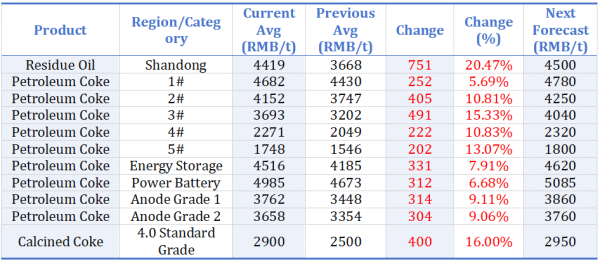
In March, downstream sectors such as electrolytic aluminum and anode materials gradually resumed production, increasing demand for raw materials. Coupled with the impact of the Iran-Israel conflict, crude oil prices rose, driving petroleum coke prices upward. Petroleum coke prices continued to increase.
In early March, petroleum coke prices were relatively stable, with slight increases. After the conflict outbreak, prices rose continuously, with an increase of RMB 200–400/t. By late March, prices began to differentiate by category. Prices at major refineries continued to rise. Among them, some refineries under Sinopec reduced output due to feedstock constraints and maintenance shutdowns, leading to tight supply and further price increases. PetroChina was less affected by feedstock issues, with some refineries cutting output, and prices remained stable. Low-sulfur coke from CNOOC was significantly influenced by downstream procurement; anode material producers participated in refinery auctions, and prices continued to rise. Carbon enterprises showed limited acceptance of high-priced raw materials, and prices were mostly stable.
For independent refineries, widespread price declines appeared in late March. The main reason was that earlier price increases were too large, and downstream buyers found it difficult to accept high-priced materials. Refineries lowered prices to ease inventory pressure. By the end of the month, independent refinery prices generally showed a downward trend.
Figure 1: 2025–2026 China petroleum coke production and capacity utilization trend (10,000 tons)
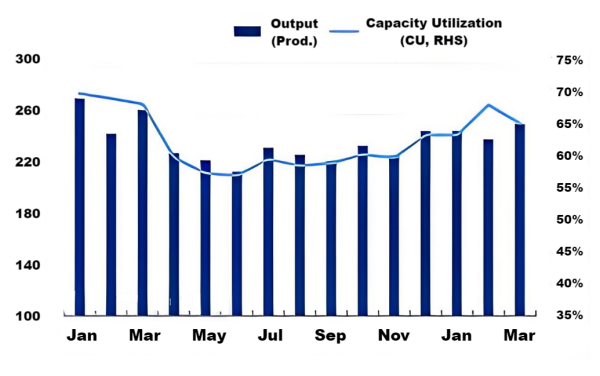
According to statistics, total domestic petroleum coke supply in March is estimated at 2.5199 million tons, an increase of 119,900 tons month-on-month, up 5%.
During March, seven delayed coking units entered maintenance (including four independent refineries), involving a total annual processing capacity of 6.45 million tons. Within the month, four delayed coking units resumed operation (all independent refineries), involving 1.65 million tons/year of capacity, and some refineries adjusted operating loads. On the import side, import volumes declined significantly, with March imports expected to fall to 1.2 million tons, down 18.32%.
Ⅱ. Profits of downstream products showed mixed performance; procurement mainly based on rigid demand
Table 2: Theoretical profit changes of petroleum coke and major downstream products (Unit: RMB/t)
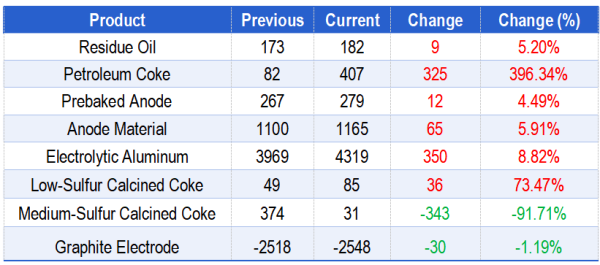
In this period, profits across the petroleum coke industry chain showed mixed changes, while delayed coking margins increased significantly. Overall, downstream product profits fluctuated. Medium-sulfur calcined coke prices rose steadily, but due to rising raw material petroleum coke costs, profits declined. Low-sulfur calcined coke average prices increased, while raw material costs also rose; however, product price increases exceeded raw material cost increases, leading to profit growth. Electrolytic aluminum profits increased due to higher average prices, and prebaked anode profits also rose driven by stronger aluminum prices. Anode materials prices remained stable, while declining petroleum coke costs reduced production costs, resulting in a slight increase in profits.
Due to demand factors, petroleum coke prices mainly increased during the month. Downstream shipments remained relatively stable, product prices rose steadily, and some products saw profit recovery.
III. Downstream demand expected to recover in April; petroleum coke prices likely to rise steadily
As of March 31, 2026, a survey of domestic petroleum coke market participants' sentiment for April shows: 30% neutral, 20% bearish, and 50% bullish. Bearish participants believe that port inventories continue to rise, domestic production may further increase, and downstream enterprises may adopt a wait-and-see attitude after restocking, leading to a "decline-then-rise" trend in April.
Figure 2: April market sentiment survey
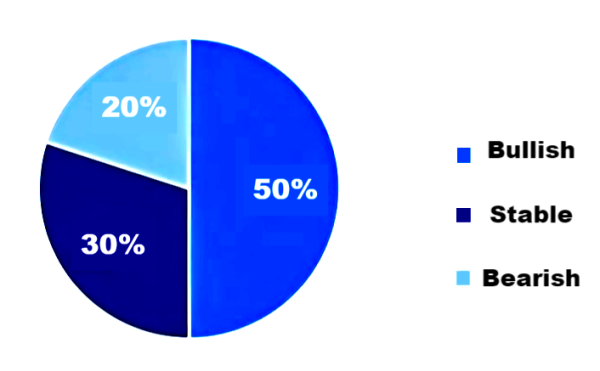
It is expected that market activity will improve in the next period. Strong cost support may provide room for significant increases in prebaked anode pricing, while demand will continue to drive petroleum coke prices upward. On the supply side, some domestic refineries will undergo planned maintenance shutdowns, tightening supply. Imported petroleum coke will gradually arrive at ports and enter storage, while stable port shipments will reduce inventories, resulting in a slight decline in overall supply. On the demand side, the traditional carbon sector is resuming operations, increasing demand, and the anode materials sector is beginning a new round of procurement, supporting petroleum coke sales.
It is expected that the petroleum coke price index will rise to RMB 2,850/t in April, up RMB 53/t month-on-month, an increase of 1.89%.
Feel free to contact us anytime for more information about the petroleum coke market. Our team is dedicated to providing you with in-depth insights and customized assistance based on your needs. Whether you have questions about product specifications, market trends, or pricing, we are here to help.
No related results found




0 Replies