




【Graphite Crucible】Material Types and Manufacturing Process

Calcined petroleum coke, with its high carbon content, low sulfur, and low impurities, plays a vital role in modern manufacturing, especially in the aluminum and steel industries.
【Graphite Crucible】Material Types and Manufacturing Process
Material Types of Graphite Crucibles
Graphite crucibles are mainly used for melting metal materials and can be divided into two types: natural graphite and artificial graphite.
Natural graphite crucibles use natural flake graphite as the main raw material, with the addition of refractory materials such as clay. They are generally referred to as clay-bonded graphite crucibles. Those using pitch as a binder are called carbon-bonded crucibles. Crucibles made solely by the sintering strength of clay are called clay-bonded crucibles. The former has excellent strength and thermal shock resistance. They are used for melting ferrous metals such as steel, as well as non-ferrous metals like copper and copper alloys. Their sizes vary, with melting capacities ranging from 250 g to 500 kg. These crucibles include slag skimmers, furnace lids, connecting rings, crucible supports, stirring bags, and other accessories. Natural graphite crucibles typically contain about 50% clay minerals, while artificial graphite crucibles have impurity (ash) content of less than 1%, and are used for refining high-purity metals and specially purified high-purity graphite melts (ash < 20 ppm). Artificial graphite crucibles are usually used for melting small quantities of precious metals, high-purity metals, high-melting-point metals, and oxides. They can also be used as crucibles for gas analysis in steel.
The materials of graphite crucibles can generally be classified as follows:
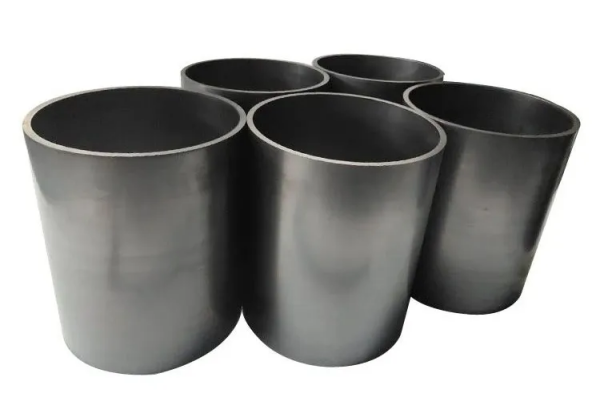
(1) Artificial graphite: Artificial graphite crucibles are processed from graphite electrode materials.
(2) Graphite-clay material (clay bonded): These crucibles are mainly composed of natural flake graphite (crystal graphite) and clay. They are now only used for high-temperature melting of cast iron, cast steel, and small quantities of precious metals.
(3) Graphite-silicon carbide material (carbon bonded): These crucibles are mainly composed of natural flake graphite and silicon carbide. Most melting of non-ferrous metals such as copper alloys and aluminum alloys uses this type of crucible. In 1955, Nippon Crucible Co., Ltd. first developed and produced graphite-silicon carbide crucibles in Japan. Due to their superior durability compared to graphite-clay crucibles, they have gradually replaced them. Currently, the demand for graphite-silicon carbide crucibles accounts for about 97% of the total.
Characteristics of Graphite Crucibles
Graphite crucibles adopt various measures in raw materials and manufacturing to meet usage under harsh conditions. The main characteristics are as follows:
(1) High thermal conductivity: The use of graphite and other materials with high thermal conductivity shortens melting time.
(2) Thermal shock resistance: Strong resistance to rapid heating and cooling, not easy to crack.
(3) High heat resistance: High refractoriness, capable of withstanding temperatures of 1200–1600°C.
(4) Corrosion resistance: Strong resistance to erosion by molten metal.
(5) Mechanical impact resistance: Possesses certain mechanical strength against impacts (e.g., during material charging).
(6) Oxidation resistance: Graphite is prone to oxidation at high temperatures in oxidizing atmospheres, but anti-oxidation treatments reduce consumption.
(7) Anti-adhesion: Graphite is not easily bonded with molten metal, resulting in low penetration and adhesion.
(8) Low metal contamination: No introduction of impurities into the melt, ensuring minimal contamination.
(9) Resistance to flux (slag remover): Good resistance to flux agents.
Shapes of Graphite Crucibles
Depending on usage, the shapes can generally be divided into:
① Standard type: Ratio of outer diameter to height is approximately 0.7–0.8:1.
② Tall type: More elongated than standard, ratio about 0.6–0.7:1.
③ Bowl type: Larger diameter, ratio approximately 1:1.
④ Spouted type: Similar to tall type but with a pouring spout.
⑤ Electric furnace type: Cylindrical and relatively slender, ratio about 0.6:1.
Manufacturing Process of Graphite Crucibles
The manufacturing process of graphite crucibles can be divided into three methods: hand molding, rotational molding, and compression molding. The quality of crucibles is closely related to the forming method. The forming method determines the structure, density, porosity, and mechanical strength of the crucible body.
Hand molding is used for special-shaped crucibles that cannot be produced by rotational or compression molding. Some special-shaped crucibles adopt a combination of rotational and hand molding.
Rotational molding uses a rotating machine to drive the mold, and the material is shaped by internal tools pressing the plastic mass.
Compression molding uses hydraulic, water, or pneumatic pressure equipment as power, with steel molds to form the crucible. Compared with rotational molding, it has advantages such as simpler process, shorter production cycle, higher yield and efficiency, lower labor intensity, lower moisture content, lower shrinkage and porosity, and higher product quality and density.
The detailed process flow is as follows:
(1) The main raw material is graphite powder, mixed with other materials. Many manufacturers want to produce this product but lack knowledge of the formulation, making them hesitant to invest. Only with a proper material ratio can qualified products be produced.
(2) The formulation requires a thermal-insulated twin-shaft mixer to thoroughly mix all materials according to the ratio.
(3) After mixing, the material is measured using a paste weighing hopper to determine the amount needed per crucible.
(3) The measured material is transported into the machine via a conveying system, designed according to site conditions.
(4) The material enters the mold for pressing. The mold is designed as a dual-station fully automatic system, allowing adjustable exhaust cycles. Stations operate alternately to improve efficiency. Demolding uses a multi-stage hydraulic system to ensure density.
(5) The core equipment is the crucible forming hydraulic press, customized according to product size. Common models include 1500-ton, 2000-ton, and 2500-ton presses.
(6) After pressing, the crucible is demolded, dried, and then fired in a furnace to complete the product.
Features of Graphite Crucibles
The production technology of domestic graphite crucibles has reached or even surpassed imported ones. High-quality domestic crucibles have the following features:
(1) High density provides excellent thermal conductivity, superior to other imported crucibles.
(2) Special glaze layer and dense forming materials improve corrosion resistance and extend service life.
(3) All graphite components use natural graphite, ensuring excellent thermal conductivity.
(4) After heating, graphite crucibles should not be placed immediately on cold metal surfaces to avoid cracking due to rapid cooling.
Preheating and Maintenance of Graphite Crucibles
Graphite crucibles must be protected from moisture, as moisture significantly affects quality. Using damp crucibles may lead to cracking, spalling, wall loss, or bottom failure, causing molten metal loss and even safety accidents.
Storage conditions:
Warehouses should be dry and ventilated, with temperatures maintained at 5–25°C and relative humidity at 50–60%. Crucibles must not be placed directly on brick or cement floors. Bulk crucibles should be placed on wooden racks 25–30 cm above ground. Packaged crucibles should be elevated at least 20 cm with sleepers, preferably with an oil felt layer for moisture protection. Stacks should be rotated periodically (every 2–3 months) to prevent moisture accumulation.
Preheating steps:
a. Hold at 200°C for 3 hours;
b. Hold at 700°C for 2 hours;
c. Hold at 900°C for 1 hour;
d. Shut down furnace and allow natural cooling;
e. Reheat to operating temperature and charge aluminum vertically;
f. During operation:
g. Do not overfill molten aluminum;
h. Do not keep too little molten metal;
i. Maintain proper molten level within 3 cm below the rim;
j. Clean molten metal before shutdown;
k. If shutdown exceeds 48 hours (24 hours in winter), repeat preheating;
l. Repeat preheating every two months to extend service life.
Applications of Graphite Crucibles
Crucibles are ideal for melting multiple alloy types in small batches. Changing alloys only requires replacing the crucible, unlike other melting methods that risk contamination.
(1) Copper alloy melting:
Rapid melting is essential due to oxidation at high temperatures. Standard crucibles are widely used, balancing melting efficiency and operability. Tilting crucible furnaces are increasingly adopted. Electric furnace crucibles are used in induction furnaces, with dry refractory materials packed between the furnace wall and crucible.
(2) Light metal alloy melting:
Widely used for aluminum alloy casting and die casting, and some zinc alloy melting. Various melting methods exist, including batch melting and combined melting/holding. Graphite crucibles are preferred over cast iron pots due to lower contamination and improved durability. Large crucibles have been developed to meet demand. Aluminum alloys melt at 700–750°C, a temperature range where graphite is prone to oxidation. Therefore, formulations emphasize oxidation resistance, while also considering the effects of fluxes such as fluorides.
Feel free to contact us anytime for more information about the artificial graphite market. Our team is dedicated to providing you with in-depth insights and customized assistance based on your needs. Whether you have questions about product specifications, market trends, or pricing, we are here to help.
No related results found




0 Replies