

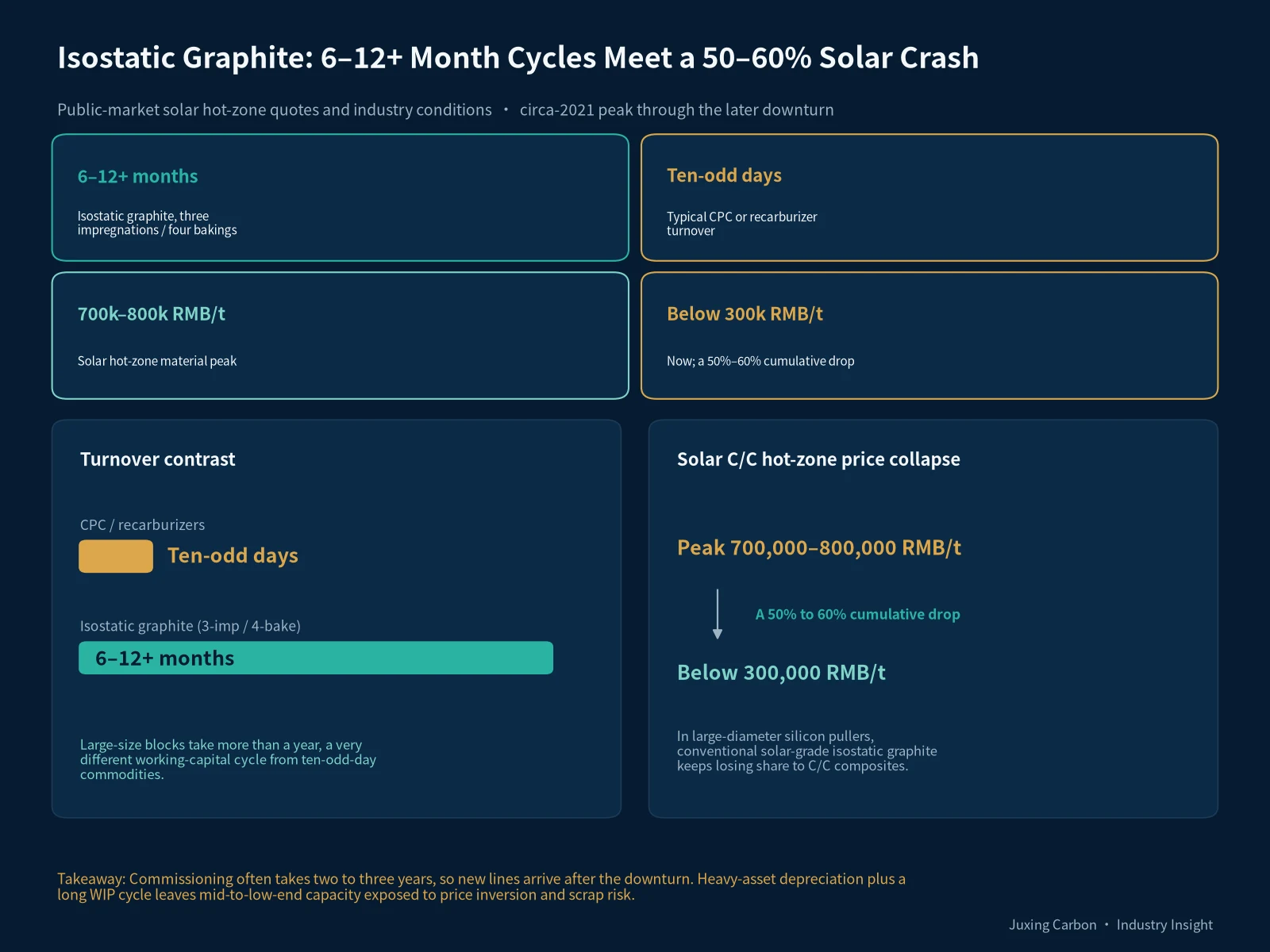
Traditional carbon plants that invested heavily to enter solar-grade isostatic graphite now face a 50%–60% plunge in hot-zone material prices alongside heavy equipment depreciation and a grueling 6-to-12+ month "three-impregnation, four-baking" production cycle.
Manufacturing qualified isostatic graphite is one of the longest and most capital-intensive processes in the carbon industry. Spanning raw material calcining, micro-milling, kneading, and cold isostatic pressing (CIP), followed by a grueling sequence of "three impregnations and four bakings" (or four impregnations and five bakings), high-temperature graphitization, and chemical purification, a single production batch takes at least six months—and for large-size blocks, more than a full year—to emerge from the furnace.
Commissioning Lag
Data basis: public-market solar hot-zone material quotes and industry operating conditions, covering the circa-2021 peak and the subsequent downturn.
Two to three years ago, gross margins of 40% to 50% and booming photovoltaic demand led many traditional prebaked anode and graphite electrode producers to view specialty graphite as an ideal transformation path. Around 2021, carbon/carbon (C/C) composite hot-zone components for monocrystalline silicon pullers reached 700,000 to 800,000 RMB/ton, while solar-grade isostatic graphite was in acute shortage. Drawn by these returns, numerous traditional carbon enterprises invested tens or hundreds of millions of RMB in imported isostatic presses and specialty baking furnaces.
However, commissioning an isostatic graphite line—from equipment installation and micro-powder formulation trials to nursing the first batch through a six-to-twelve-month baking cycle—typically requires two to three years. By the time these crossover projects achieved stable output over the past year or two, the downstream photovoltaic silicon wafer sector had entered a severe overcapacity downturn.
Hot-Zone Price Collapse
In the open market, solar C/C composite hot-zone prices have fallen from 700,000–800,000 RMB/ton to below 300,000 RMB/ton, representing a 50% to 60% drop. Meanwhile, in large-diameter silicon pullers, conventional solar-grade isostatic graphite has lost market share to C/C composites, dragging mid-to-low-end isostatic graphite prices steadily lower.
| Item | Public figure | What it shows |
|---|---|---|
| Solar C/C hot-zone peak | Around 2021, 700,000–800,000 RMB/ton | The boom that drew crossover investment |
| Current prices | Have fallen below 300,000 RMB/ton | Now sitting below the cost band |
| Cumulative decline | A 50% to 60% drop | A deep hot-zone price reset |
| Large-diameter pullers | C/C composites keep taking share | Mid-to-low-end isostatic demand stays under pressure |
Note: Prices and the decline band follow the source’s public-market figures; the source does not state capacity tonnage or plant-level quotes, so none are added here.
For crossover producers, the financial exposure in isostatic graphite is fundamentally different from fast-turnover commodities like calcined petroleum coke (CPC) or recarburizers:
| Item | Public figure | What it shows |
|---|---|---|
| CPC or recarburizer turnover | Just over ten days | Short cash conversion, easier to adjust |
| Isostatic graphite cycle | 6 to 12+ months (three impregnations, four bakings) | Working capital sits in WIP for a long time |
| Large-size blocks | More than a full year | Finished prices can invert against historical WIP costs |
| Process risk | A temperature-control error in one baking step can crack a block internally | Half a year of furnace time can turn into scrap |
Note: Turnover and cycle figures follow the source; “three impregnations and four bakings” (or four impregnations and five bakings) is the source process wording, not an inferred furnace schedule.
1. Rigid Heavy-Asset Depreciation: Cold isostatic presses, high-pressure impregnation autoclaves, specialty baking furnaces, and purification furnaces carry massive fixed depreciation and interest expenses whenever downstream silicon pullers cut operating rates.
2. A 6-to-12+ Month Work-in-Process (WIP) Trap: Because ultra-fine isotropic blocks crack easily if volatile gases escape too rapidly, heating curves must proceed extremely slowly across three impregnations and four bakings. Feedstock loaded six to twelve months ago emerges today into a market where finished prices sit below historical WIP costs. Furthermore, any temperature-control deviation during a single baking step can induce internal cracks, turning half a year of furnace time into scrap carbon.
Depreciation, WIP and Implications
While semiconductor-grade ultra-high-purity and ultra-large-size isostatic graphite remain protected by deep technical moats, undifferentiated mid-to-low-end capacity built during the solar boom faces a prolonged shakeout.