




【Petroleum Coke】From Classic Patterns to Short-Term Divergence — Market Dynamics ...

Calcined petroleum coke, with its high carbon content, low sulfur, and low impurities, plays a vital role in modern manufacturing, especially in the aluminum and steel industries.
【Petroleum Coke】From Classic Patterns to Short-Term Divergence — Market Dynamics and Future Outlook
According to statistics from Aladdin (ALD), a chart has been generated showing China's petroleum coke port inventory and average price trends from 2023 to 2026. Overall, over the past three years, China's petroleum coke market has vividly demonstrated the classic "negative correlation" between inventory and prices in supply–demand theory. However, in early February 2026, the market presented a seemingly contradictory picture: port inventories continued to rise, while the national average price remained relatively stable with slight fluctuations. This phenomenon has broken previous patterns. Behind it lies short-term structural divergence in the market, which may also signal the possibility of a new round of changes.
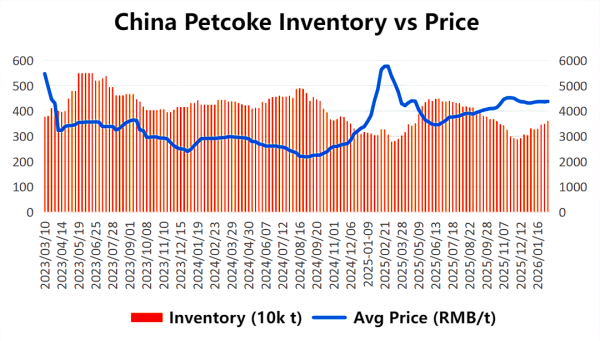
Data Source: Aladdin (ALD)
Historical Review: The "Seesaw" Driven by Supply and Demand
For most of the period from 2023 to 2025, the market followed clear economic logic:
High inventory suppresses prices:
When port inventories accumulated, it indicated abundant supply or weak demand. Buyers gained stronger bargaining power, putting downward pressure on prices.
Low inventory supports prices:
When inventories were rapidly depleted, it reflected tightening supply or strong demand. Sellers gained the initiative and pushed prices higher.
Current Paradox: A "Strange Balance" Caused by Structural Divergence
The unusual market behavior before the 2026 Spring Festival originates from significant structural division within the petroleum coke market, temporarily masking the overall supply–demand relationship.
Supply-Side Divergence
Abundant domestic petcoke (independent refinery output):
Local refineries have maintained relatively high operating rates, resulting in ample domestic petroleum coke supply with relatively low costs.
Imported petcoke caught in a dilemma:
Imported petroleum coke is supported by high international costs, keeping CIF prices at elevated levels. The significant price gap compared with domestic material has resulted in a situation of "available but difficult to sell," with slow shipments and large volumes accumulating at ports.
Demand-Side Selective Procurement
Downstream companies currently hold medium-to-high inventory levels, reducing the urgency of procurement. Under conditions of overall supply abundance, downstream buyers naturally prefer cost-effective domestic petroleum coke, leading to weak demand for high-priced imported material.
This has created a unique situation: total port inventories are rising due to imported petcoke accumulation, while the material actually circulating and determining market prices is mainly domestic petcoke. The ample supply and stable pricing of domestic material have kept the national average price relatively stable with mild fluctuations.
High imported costs form the market's "price ceiling," while abundant domestic supply establishes the "price floor." The market has reached a temporary and fragile equilibrium within a narrow price range.
Outlook: Fragile Balance with Increasing Downward Pressure
The current "strange balance" is unlikely to last. Multiple factors are building downward pressure:
Risk of an inventory "dammed lake":
Continuous arrivals of imported petcoke combined with slow sales have caused port inventories to keep rising. If total inventory exceeds the critical psychological level of 4 million tons and approaches physical storage limits, traders holding imported cargoes will face significant financial and storage pressure. This may trigger price-cutting sales to recover cash flow, directly impacting the market price structure.
Demand-side inventory cycle:
After the holiday, if downstream operating rates recover more slowly than expected, or if internal inventories are digested at a slow pace, demand for new purchases will remain suppressed and oversupply pressure will intensify.
Price spread convergence logic:
The large domestic–import price spread cannot be sustained indefinitely. Either strong domestic demand will push domestic prices upward toward imported levels, or imported cargoes will be forced to lower prices to penetrate the domestic market. Under the current conditions of overall supply abundance, the latter scenario is far more likely.
Conclusion
China's petroleum coke market is shifting from a classic total supply–demand balance toward a more complex structural competition phase.
The short-term pattern of "stable prices with rising inventories" is a special result of inverted cost relationships between imported and domestic material and segmented circulation channels.
Market monitoring should shift from focusing solely on total inventory figures to examining:
■ The share and cost structure of imported petcoke within port inventories
■ Changes in independent refinery operating rates
■ The actual consumption pace of downstream enterprises
The direction of the next market cycle will depend on when the elevated imported inventory "dammed lake" is released and how that release impacts the overall pricing system.
Traders and downstream enterprises should remain alert to price risks arising from the realization of post-holiday inventory pressure.
Feel free to contact us anytime for more information about the petroleum coke market. Our team is dedicated to providing you with in-depth insights and customized assistance based on your needs. Whether you have questions about product specifications, market trends, or pricing, we are here to help.
No related results found




0 Replies