



【Anode Materials】March 2026 Market Analysis

The rapid growth of the EV and energy storage industries is boosting demand for high-performance lithium batteries, driving the market for quality petroleum coke and synthetic graphite. The quality and particle size of calcined petroleum coke directly affect synthetic graphite performance, especially in anode production.
【Anode Materials】March 2026 Market Analysis
NO.1 Market Overview
In March 2026, the anode materials market showed a trend of "high-cost operation and price stalemate with temporary stability."
From the cost side, affected by the tightening domestic supply of petroleum coke and the escalation of the Middle East situation, shipping through the Strait of Hormuz was disrupted, impacting the transportation of crude oil and petroleum coke. This further pushed up domestic petroleum coke and green needle coke prices, leading to a significant increase in raw material costs and further compressing profit margins for anode material enterprises.
From the demand side, in March, inquiries and order volumes in the anode materials market showed a steady increase, and production enthusiasm among anode enterprises improved, with some companies increasing their operating rates.
Overall, anode material enterprises are facing high costs and difficulty in raising prices. Prices remain in a stalemate and temporarily stable pattern, and market wait-and-see sentiment is gradually intensifying.
NO.2 Market Analysis
(1) Anode Material Prices
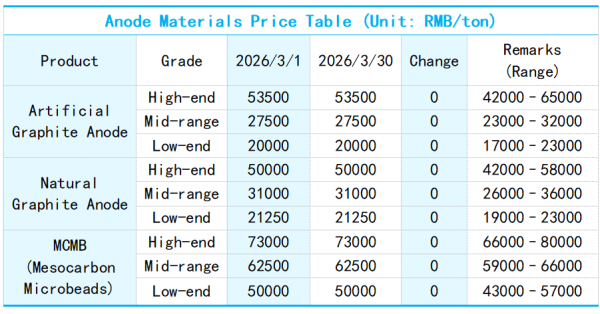
In March, the average price of lithium battery anode materials was RMB 33,100/ton, remaining stable compared to February. Among them, mainstream prices for high-end anode materials were RMB 42,000–65,000/ton, mid-range materials were RMB 23,000–32,000/ton, and low-end materials were RMB 17,000–23,000/ton.
Table: Monthly Price Changes of Lithium Battery Anode Materials (RMB/ton)
Source: BAIINFO
(2) Raw Materials and Processing
1. Raw Material Market
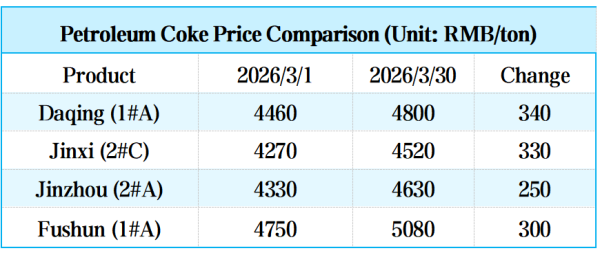
Petroleum Coke: In March, prices of refineries under PetroChina mainly increased. Downstream purchasing enthusiasm was strong, and overall market trading sentiment was positive. Refineries in Northeast China had no pressure on shipments, with significant price increases. In Northwest China, demand from the aluminum carbon sector remained stable, providing rigid demand support. In Southwest China, Yunnan Petrochemical raised prices, with stable demand from the carbon sector and limited shipments for anode use.
Table: China Petroleum Coke Reference Prices This Month (RMB/ton)
Source: BAIINFO
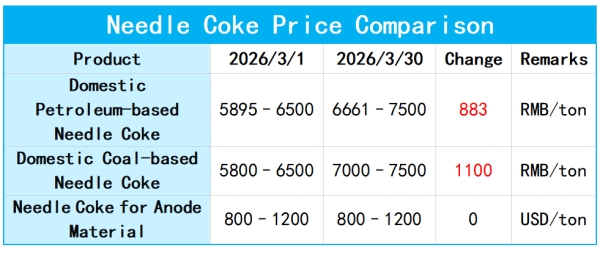
Needle Coke: In March, the needle coke market rose and then remained at a high-level stalemate.
Petroleum-based needle coke was supported by rising raw material costs and tight supply, with prices increasing throughout the month. In mid-to-late March, due to difficulties in raw material procurement, tight supply, and strong resistance from downstream markets to high-priced resources, the market remained in a high-level stalemate.
For coal-based needle coke, driven by price increases in petroleum-based needle coke, downstream anode material buyers showed increased inquiry activity and order volume. However, due to high raw material costs and unclear market trends, some enterprises suspended quotations. Demand at high prices was weak, but overall, coal-based quotations also trended upward, with slow actual transactions and strong but supply-demand game dynamics.
Table: China Needle Coke (Green Coke) Prices This Month (RMB/ton)
Source: BAIINFO
2. Graphitization Processing
In March, for integrated graphitization: terminal demand from energy storage and power sectors continued to be released. Integrated anode enterprises maintained good operating conditions, with leading companies operating at high levels. Some previously suspended enterprises began preparations to resume production due to improved demand. High-quality graphitization capacity remains relatively tight. Coupled with rising calcined coke prices, graphitization costs increased, and some outsourcing graphitization service providers raised their quotations.
For independent graphitization: the recovery of demand from power and energy storage sectors drove increased production scheduling among anode material enterprises. Some independent graphitization companies had full orders and maintained high operating rates. Enterprises that had previously reduced or halted production are planning to resume and increase output, with a slight recovery in market sentiment.
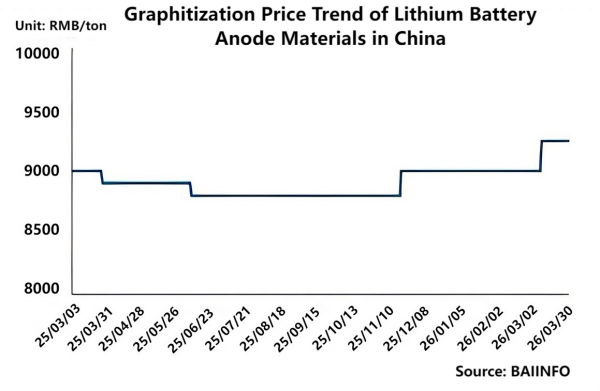
In March, graphitization processing fees increased due to rising costs and continued downstream demand support, with active transactions. The average graphitization processing fee for anode materials was RMB 8,500–10,000/ton.
In terms of cost: in March, the production cost of lithium battery anode graphitization enterprises was RMB 8,169.57/ton, up 1.44% month-on-month.
In terms of profit: the production profit was approximately RMB 634.9/ton, down 9.04% month-on-month. Rising auxiliary material prices, higher electricity costs in some regions, and slight increases in graphitization processing fees led to limited profit margins.
(3) Output
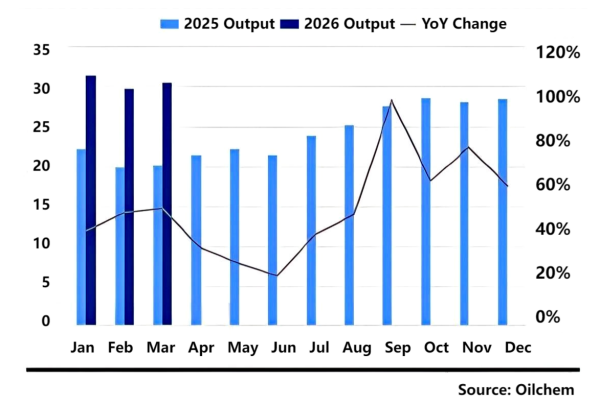
In March, production of anode materials recovered. Except for a few leading enterprises with reduced operating rates, most companies saw steady increases in output, leading to overall production growth. Total output in March reached 305,700 tons.
(4) Cost and Profit
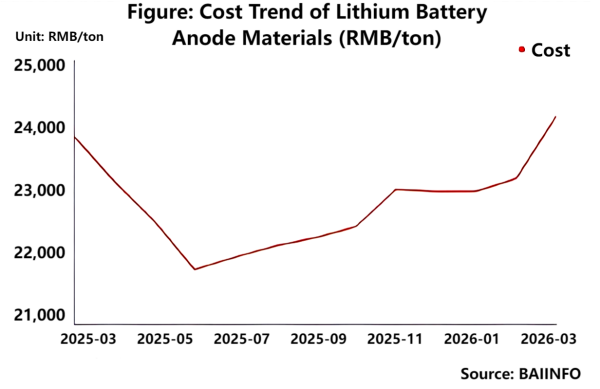
In March, the cost of lithium battery anode materials was approximately RMB 24,156.62/ton, an increase of RMB 945.21/ton compared to February, up 4.07%.
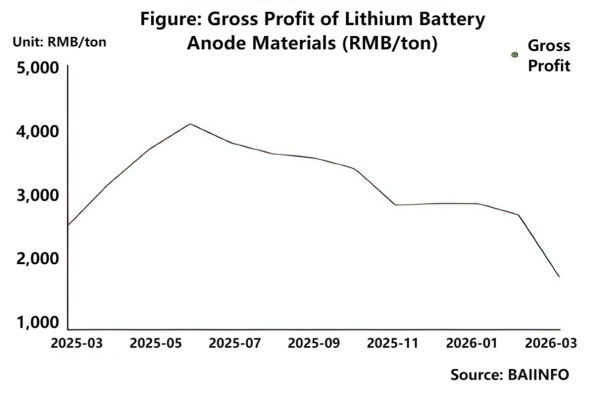
In March, the gross profit of lithium battery anode materials was approximately RMB 1,795.7/ton, down 34.5% month-on-month. As production costs continued to rise while prices remained stable, profit margins for anode enterprises declined.
NO.3 Market Outlook
Table: Analysis of Factors Affecting Lithium Battery Anode Material Prices in March 2026
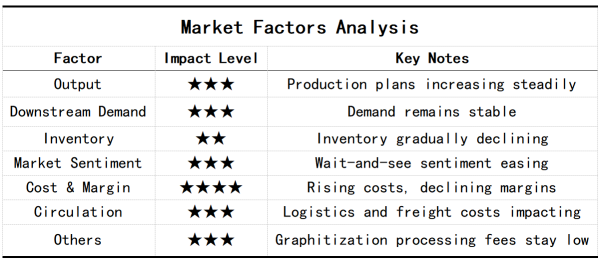
Source: BAIINFO
From a policy perspective, in 2026, the government continues to intensify policies such as trade-in subsidies for automobiles and home appliances, and increase subsidy standards for new energy city buses and power battery replacements. These policy benefits are expected to stimulate demand in new energy vehicles, consumer electronics, and energy storage markets, thereby driving steady growth in anode material demand.
From an industry structure perspective, under the background of structural overcapacity, leading anode enterprises, with strong capital chains, sufficient capacity, and technological advantages, maintain relatively stable orders. Meanwhile, small and medium-sized enterprises face limited access to orders, and competition remains intense due to limited incremental demand.
Overall, bullish and bearish factors are intertwined in the anode material market. The industry continues to focus on cost reduction, profit margins have become increasingly transparent, and downstream battery manufacturers maintain strong price pressure. It is expected that in April, anode material prices will continue to remain in a stalemate and temporarily stable pattern.
Feel free to contact us anytime for more information about the Anode Material market. Our team is dedicated to providing you with in-depth insights and customized assistance based on your needs. Whether you have questions about product specifications, market trends, or pricing, we are here to help.
No related results found




0 Replies