

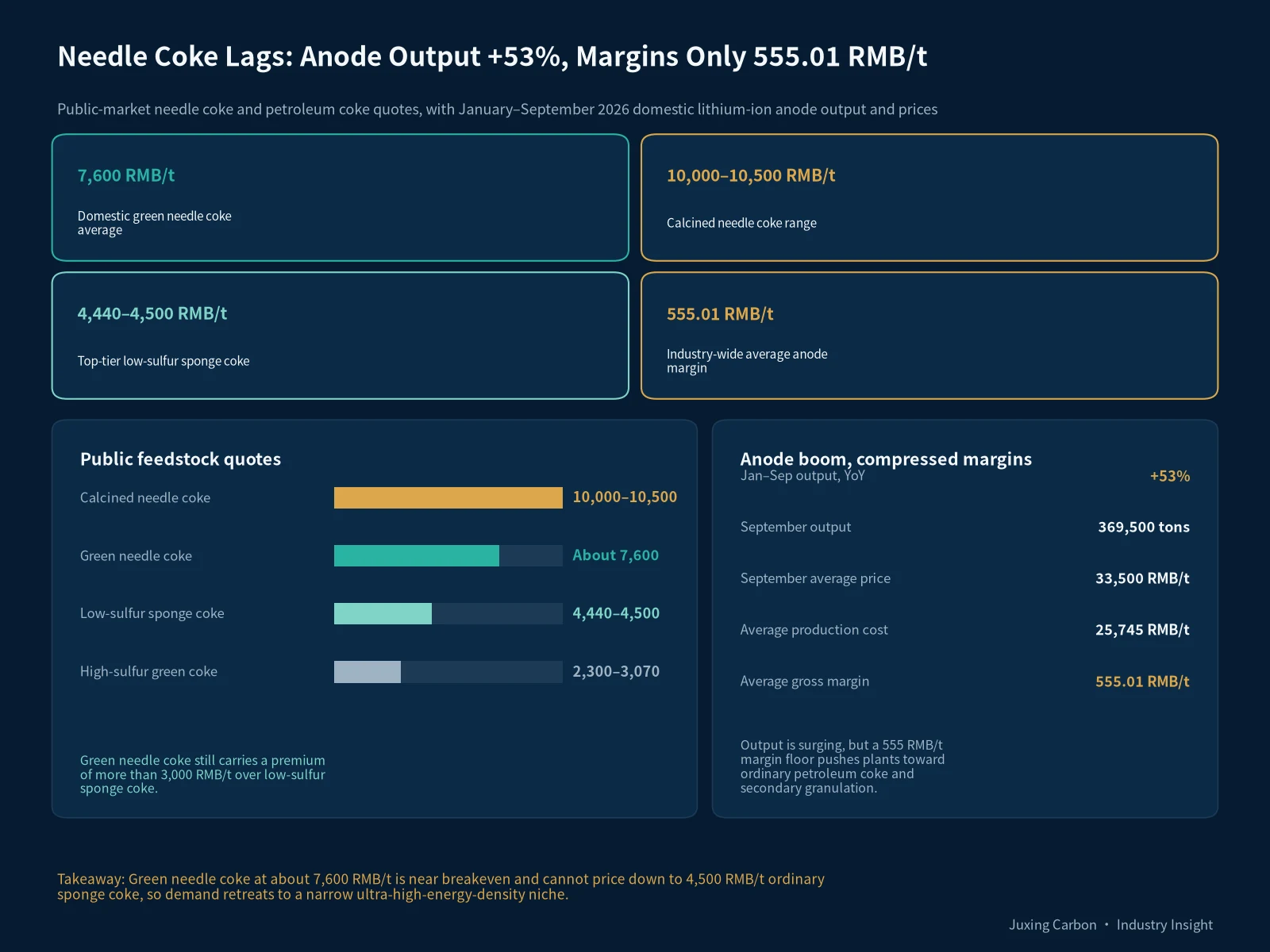
Even as China’s lithium-ion anode output surges 53% year-on-year, green needle coke at 7,600 RMB/ton and calcined needle coke at 10,000–10,500 RMB/ton face sluggish demand because anode makers have largely replaced them with 4,500 RMB/ton ordinary petroleum coke via secondary granulation.
A striking divergence has emerged between China’s booming synthetic graphite anode output and the sluggish domestic needle coke market. In September, domestic lithium-ion anode production reached 369,500 tons, bringing cumulative nine-month output to 2.7312 million tons—a 53% year-on-year expansion. Yet needle coke, once the indispensable crown-jewel feedstock for synthetic graphite anodes, remains mired in low utilization: domestic green needle coke averages roughly 7,600 RMB/ton and calcined needle coke hovers at 10,000 to 10,500 RMB/ton amidst tepid spot trading.
Demand Divergence
Data basis: public-market needle coke and petroleum coke quotes, together with January–September 2026 domestic lithium-ion anode output and price observations.
The root cause of this disconnect lies in a sweeping formulation shift across anode workshops: to survive severe margin compression, anode producers have engineered a "de-needle-coking" process revolution using ordinary petroleum coke and secondary granulation.
In September, average domestic synthetic graphite anode prices stood at 33,500 RMB/ton (with mainstream LFP grades at 17,500–24,000 RMB/ton) against an average production cost of 25,745 RMB/ton, leaving an industry-wide average gross margin of just 555.01 RMB/ton. Operating on a 555 RMB/ton margin floor forces R&D and procurement teams to replace every high-cost feedstock in the bill of materials.
Feedstock Spread and Process Substitution
Even after falling to 7,600 RMB/ton for green grades and 10,000–10,500 RMB/ton for calcined grades, needle coke remains far more expensive than standard petroleum coke: Shandong high-sulfur green coke trades at 2,300–3,070 RMB/ton, and top-tier domestic low-sulfur sponge coke sits at 4,440–4,500 RMB/ton—giving ordinary low-sulfur coke a cost advantage of more than 3,000 RMB/ton over green needle coke and more than 50% over calcined needle coke.
| Feedstock | Public quote | What it shows |
|---|---|---|
| Green needle coke | About 7,600 RMB/ton | Premium of 3,000+ RMB/t vs low-sulfur sponge coke |
| Calcined needle coke | 10,000–10,500 RMB/ton | Ordinary coke has a cost advantage of more than 50% |
| Shandong high-sulfur green coke | 2,300–3,070 RMB/ton | The lower band of ordinary petroleum coke prices |
| Top-tier low-sulfur sponge coke | 4,440–4,500 RMB/ton | Ordinary-coke benchmark needle coke cannot match |
Note: Quotes follow the source’s public-market figures. The “more than 3,000 RMB/ton” premium and the “more than 50%” gap versus calcined needle coke are the source wording; no tighter spread is inferred.
Historically, anode makers relied on needle coke’s natural acicular crystalline structure to achieve high specific capacity and low electrode swelling. Today, producers bridge that raw material gap through process engineering—combining micro-powder shaping, secondary granulation, and pitch surface coating to upgrade ordinary low-sulfur sponge coke and green petroleum coke into functional substitutes for needle coke. Outside of a narrow tier of ultra-high-energy-density EV cells, mainstream power and energy-storage anodes have cut needle coke blending ratios to historic lows.
Cost Floor and Implications
| Item | Public figure | What it shows |
|---|---|---|
| September lithium-ion anode output | 369,500 tons | Downstream monthly output remains high |
| January–September cumulative output | 2.7312 million tons, +53% year on year | Anode growth diverges from a sluggish needle coke market |
| September average anode price | 33,500 RMB/ton | Mainstream LFP grades at 17,500–24,000 RMB/ton |
| Average production cost | 25,745 RMB/ton | Costs sit near the top of the mainstream selling range |
| Industry-wide average gross margin | 555.01 RMB/ton | A 555 RMB/ton floor forces feedstock substitution |
Note: Output, prices, cost and margin figures follow the source. No plant names, capacity tonnage, or utilization rates beyond the source are added.
Because oil-based and coal-based needle coke producers are themselves pinned against high slurry oil and coal tar pitch feedstock costs near the 7,600 RMB/ton breakeven line, they cannot price down to 4,500 RMB/ton to compete with ordinary sponge coke. Process substitution has permanently reshaped the anode feedstock hierarchy.